In brief: Ceramic coating and PPF SEO works best when each service has a distinct commercial page that answers the buyer’s real questions, shows permissioned project proof, explains limitations and aftercare, and links to useful supporting content. Clear, verifiable facts help customers, search engines, and AI-answer systems understand the service without special “AI SEO” tricks.
Ceramic coating and paint protection film are often grouped together because both relate to vehicle protection. They are not the same purchase. The installation, coverage, preparation, limitations, care, quote process, and customer expectations differ. Search architecture should reflect those differences.
For the complete commercial offer, see our digital marketing for detailing, PPF, and ceramic coating shops.
Give coating and PPF separate page ownership
A detailing business that genuinely offers both services will usually benefit from separate commercial owners:
- Ceramic coating page: paint preparation, coating system, suitable vehicles, maintenance, durability factors, limitations, warranty terms, and estimate process.
- Paint protection film page: coverage options, film characteristics, preparation, installation approach, edges and seams, care, replacement considerations, limitations, and quote process.
A general detailing page can introduce both, but it should link to the distinct service owner instead of trying to rank for every premium-service question itself.
What a ceramic coating page should explain
The page should help a vehicle owner understand the service before requesting a quote:
- What a ceramic coating is in plain language.
- What it can and cannot protect against.
- Why wash, decontamination, inspection, and possible correction matter.
- Which coating systems the installer is authorized and qualified to offer.
- How vehicle condition and customer goals affect the recommendation.
- What cure, handoff, maintenance, and warranty requirements apply.
- Whether pricing is packaged, inspected, or quoted.
- What information the customer should provide next.
Avoid universal lifespan or hardness claims when the outcome depends on product, preparation, environment, maintenance, and terms. Link product claims to the manufacturer’s current documentation when they are important to the buying decision.
What a PPF page should explain
A useful paint protection film page should cover:
- Available coverage patterns, such as high-impact areas or full-body installation.
- Film options the shop actually installs.
- How paint condition, prior repair, or aftermarket panels can affect the process.
- The shop’s approach to templates, edges, seams, disassembly, and inspection where it can be described accurately.
- Typical process stages without promising a universal turnaround.
- Care, warranty, damage, repair, and replacement considerations.
- The estimate inputs: vehicle, desired coverage, condition, timing, and photos or inspection.
The goal is not to publish trade secrets. It is to remove uncertainty and demonstrate a credible process.
Build project proof that can be evaluated
For each approved project, publish more than a gallery. Include:
- vehicle and service selected;
- starting condition and customer objective;
- preparation performed;
- coverage or coating system;
- relevant constraints or limitations;
- completed-work images with descriptive captions; and
- care or follow-up guidance.
Do not imply that one project represents a typical outcome. Keep customer information private and record permission for imagery, specifications, and testimonials.
Add supporting content without cannibalizing the service page
The commercial page owns “ceramic coating,” “PPF,” and local service intent. Supporting guides should target the decisions around the service, such as:
- coating versus PPF for different protection goals;
- what paint correction changes before coating;
- how PPF coverage options differ;
- coating maintenance and washing guidance;
- how to prepare for an estimate or inspection; and
- questions to ask an installer.
Each guide should link to the correct commercial owner. The service page can link back to the strongest guide and project. This makes the cluster useful without creating several pages that answer the same core commercial query.
Google’s crawlable-link guidance recommends standard links and descriptive anchor text. A logical link structure is also useful to customers navigating between education, proof, and a quote.
Support local visibility accurately
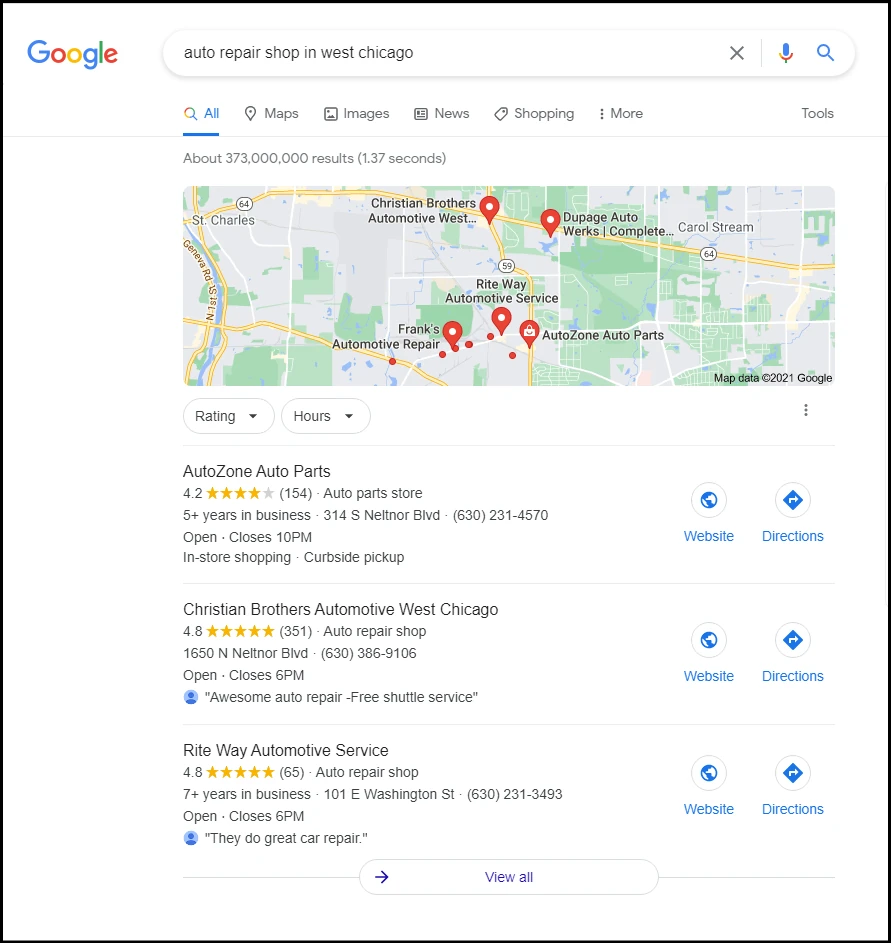
Keep the website and Google Business Profile aligned on business name, location or service-area model, hours, phone, categories, services, and appointment process. Google describes relevance, distance, and prominence as the main local ranking factors in its official guidance.
Create location pages only where the business genuinely serves customers and can add distinct, useful information. Do not imply an office or installation facility that does not exist. Original project evidence from the actual market is more useful than a page that merely swaps a city name.
Make the pages useful for AI answers
AI-answer visibility depends on many systems outside a shop’s control, so no page can guarantee inclusion or citation. The controllable work is straightforward:
- answer the main question near the top;
- use descriptive headings and concise definitions;
- state service fit, process, limitations, and next steps clearly;
- identify the business and author accurately;
- cite primary sources for external claims;
- publish first-party experience and proof; and
- keep important content in crawlable initial HTML.
Google’s people-first content guidance is a useful quality check: content should serve a real audience, demonstrate first-hand expertise, and have a clear purpose. Do not add FAQ or other structured data for content that is not visible on the page.
Measure useful commercial outcomes
Track Search Console queries and landing pages, but reconcile them with calls, forms, bookings, requested services, qualification, estimates, and accepted jobs. Coating and PPF demand should be distinguishable in the inquiry record.
Our Doctor Detail case study documents visibility for focused Ferrari PPF and paint-correction queries during one reported campaign. The case study provides historical evidence and should not be treated as a forecast for another business.
Use the auto detailing marketing plan for the wider service, GBP, review, booking, and measurement system. Auto Shop Digital’s Foundation plan can manage the connected implementation.
Frequently asked questions
Should ceramic coating and PPF be on the same page?
A hub may introduce both services, but separate commercial pages are usually appropriate when the shop genuinely offers both because the process, customer questions, proof, and quote path differ.
Does FAQ schema make a detailing shop appear in AI answers?
No markup guarantees visibility or citation. Visible, accurate answers and valid structured data can help machines understand content, but authority, relevance, retrieval, and each platform’s systems also matter.
How many city pages should a PPF installer create?
Only as many as the business can support with genuine service coverage and distinct, useful evidence. Avoid near-duplicate city pages and false location signals.
What is the best proof for coating or PPF SEO?
Permissioned project pages are strong first-party evidence when they clearly document the vehicle, starting condition, objective, preparation, installed service, limitations, and care guidance.