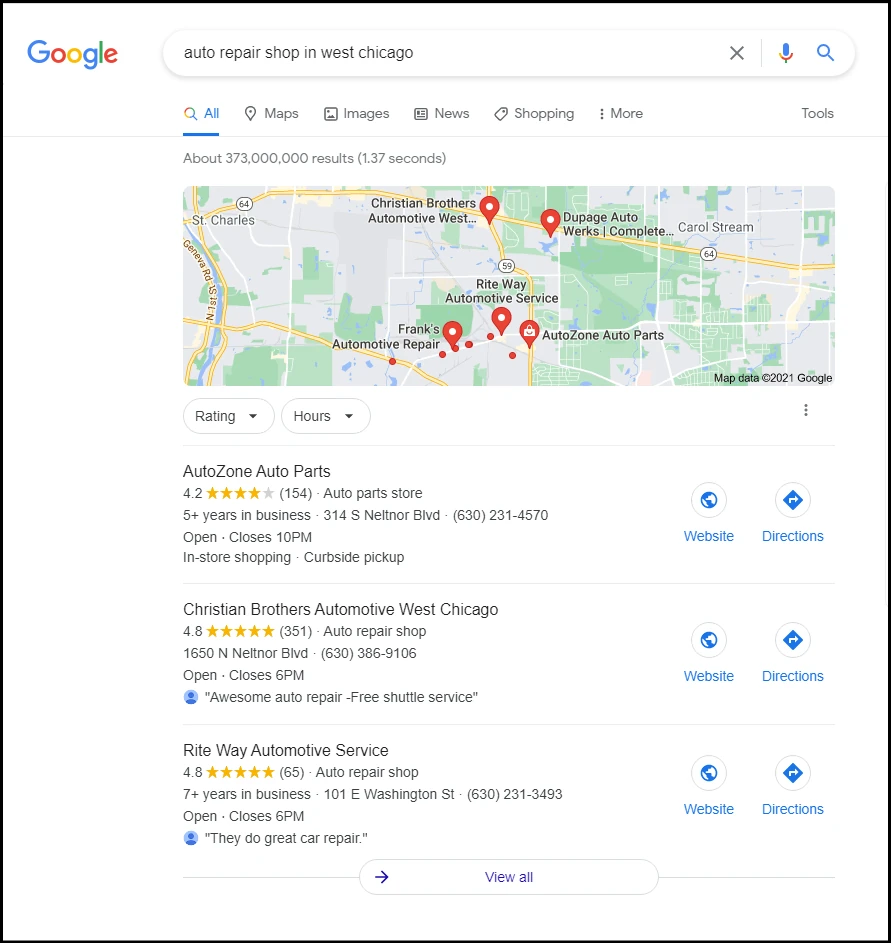
TL;DR: Local SEO for auto repair shops in 2026 means dominating the Google Map Pack, building a review pipeline, and publishing content that answers the questions drivers search before they call. Shops that combine technical SEO, Google Business Profile optimization, and consistent content publishing consistently outrank competitors who rely on paid ads alone. This guide covers every component, with specific actions you can take this week.
Why SEO Matters More Than Ever for Auto Repair Shops
When a driver's check engine light comes on, they don't open the Yellow Pages — they search "mechanic near me" on their phone. The top three results in the Google Map Pack capture 68% of all clicks on that search. If your shop isn't in those three results, you're invisible to the majority of potential customers at the exact moment they're ready to buy.
SEO is the process of earning those positions. Unlike paid ads, which stop the moment you stop paying, SEO compounds over time. A well-optimized shop that earns strong rankings in January will still benefit from that work in December — and the year after that.
The economics are compelling: organic search leads cost 61% less than outbound leads on average, and customers who find you through search are already pre-qualified — they're looking for exactly what you offer.
How Google Ranks Local Auto Repair Shops
Google's local ranking algorithm evaluates three factors:
| Factor | What it means | How to improve it | |---|---|---| | Relevance | Does your business match the search? | Optimize your GBP categories, website service pages, and content | | Distance | How close is your shop to the searcher? | Can't change your location, but accurate address data matters | | Prominence | How well-known and trusted are you? | Reviews, citations, backlinks, website authority |
You can't change your location, but you can dramatically improve relevance and prominence — and those two factors are what separate the top 3 from everyone else.
1. Google Business Profile: The Foundation of Local SEO
Your Google Business Profile (GBP) is the single most important SEO asset for an auto repair shop. It powers your Map Pack listing, drives phone calls, and influences your organic rankings.
Complete every section
- Business name: Use your exact legal business name. Do not stuff keywords into the name field — Google penalizes this.
- Address: Must match your website and every directory listing exactly. Even minor variations (St vs Street) can hurt rankings.
- Phone number: Use a local number, not a toll-free number. Use the same number everywhere.
- Website: Link to your homepage or a location-specific landing page.
- Hours: Keep these accurate and updated. Incorrect hours are one of the most common reasons customers leave negative reviews.
- Primary category: "Auto Repair Shop" for most shops. Use the most specific category that describes your primary service.
- Secondary categories: Add up to 10. Use them for every major service: Tire Shop, Brake Shop, Oil Change Service, Transmission Shop, etc.
- Services: Add every service you offer with descriptions. This helps Google match your profile to more searches.
- Attributes: Mark relevant attributes: "Identifies as veteran-owned," "Wheelchair accessible," "Appointment required," etc.
Photos: the most underutilized GBP feature
Shops with 100+ photos receive significantly more calls than those with fewer than 10. Upload:
- Exterior photos (from multiple angles, at different times of day)
- Interior photos (waiting area, service bays, equipment)
- Team photos (technicians at work, service advisors)
- Before/after repair photos
- Completed jobs (with customer permission)
Upload new photos every week. GBP rewards active profiles.
GBP posts
GBP posts appear in your listing in search results and Maps. Post weekly with:
- Current promotions and seasonal offers
- Completed jobs and before/after photos
- Maintenance tips and seasonal reminders
- New equipment or certifications
- Community involvement
Posts expire after 7 days, so consistency matters.
Q&A management
The Q&A section on your GBP allows anyone to ask (and answer) questions about your business. Monitor it weekly:
- Answer every question promptly and thoroughly
- Pre-populate common questions yourself (you can ask and answer your own questions)
- Flag and report inaccurate answers from others
2. Review Management: The Biggest Ranking Factor You Control
Reviews are the most influential factor in both Map Pack rankings and customer conversion. A shop with 4.8 stars and 200 reviews will consistently outperform a shop with 4.2 stars and 20 reviews — even if the lower-rated shop has better technical SEO.
How to generate reviews systematically
The shops that dominate reviews don't rely on customers volunteering them — they have a system:
- At checkout: Service advisor says, "We'd love a review if you're happy with the service — I'll text you a link right now."
- Same-day text: Automated message with a direct link to your Google review form (not your GBP homepage — the direct review link)
- Follow-up: If no review after 3 days, one follow-up text or email
- QR code: At the front desk, on receipts, and on business cards
Target: 5+ new reviews per month. Shops in competitive markets should aim for 10+.
How to respond to reviews
Respond to every review — positive and negative — within 48 hours.
For positive reviews:
- Thank the reviewer by name
- Mention the specific service they received
- Invite them back
For negative reviews:
- Acknowledge the issue without being defensive
- Apologize for the experience
- Offer to make it right (provide a phone number or email)
- Keep it brief — the response is for future readers, not just the reviewer
What never to do:
- Never offer incentives for positive reviews (violates Google's policies and FTC guidelines)
- Never argue with a reviewer publicly
- Never ask for reviews only from customers you know are happy (review gating violates Google's policies)
3. On-Page SEO: Optimizing Your Website for Local Search
Your website is the hub that all other SEO channels point to. A well-optimized website reinforces your GBP, earns organic rankings for service keywords, and converts visitors into customers.
Service pages: the most important pages on your site
Every major service you offer should have its own dedicated page. Each service page should:
- Target a specific keyword cluster: "brake repair [city]," "brake service [city]," "brake shop near me"
- Include the city in the H1 and title tag: "Brake Repair in [City] | [Shop Name]"
- Describe the service in detail: What's included, how long it takes, what signs indicate you need it
- Include pricing guidance: Even a range ("typically $150–$400 depending on vehicle") builds trust
- Include a clear CTA: "Book an Appointment" or "Call Us Now" with a click-to-call number
- Include trust signals: ASE certification, warranty information, years in business
Title tags and meta descriptions
- Title tag format: "[Service] in [City] | [Shop Name]" (under 60 characters)
- Meta description: 150–160 characters, include the primary keyword and a CTA. Example: "Expert brake repair in Austin, TX. Same-day service, ASE-certified technicians. Call (512) 555-0100 or book online."
NAP consistency
Your Name, Address, and Phone number must be identical on:
- Every page of your website (typically in the footer)
- Your Google Business Profile
- Every directory listing
- Your social media profiles
Even minor inconsistencies (abbreviating "Street" to "St" in one place) can confuse Google and hurt rankings.
Schema markup
Schema markup is code that tells search engines exactly what your content means. For auto repair shops, implement:
- LocalBusiness schema: Your business name, address, phone, hours, and coordinates
- Service schema: Each service you offer with description and price range
- FAQPage schema: Common questions and answers on service pages
- Review/AggregateRating schema: Your overall rating and review count
Schema markup can earn rich results in search (star ratings, FAQ dropdowns) that dramatically increase click-through rates.
Website performance
Google uses page speed as a ranking factor, especially on mobile. Target:
- Page load time under 3 seconds on mobile
- Core Web Vitals: LCP under 2.5s, FID under 100ms, CLS under 0.1
- HTTPS (secure connection)
- Mobile-responsive design
Test your site at PageSpeed Insights and fix any issues flagged as "Opportunities."
4. Local Keyword Research for Auto Repair Shops
Keyword research identifies the specific terms your potential customers use when searching for services. Targeting the right keywords is the difference between ranking for searches that drive calls and ranking for searches that drive nothing.
Keyword categories for auto repair shops
High-intent service keywords (customers ready to book):
- "[service] near me" — "oil change near me," "brake repair near me"
- "[service] [city]" — "transmission repair Austin," "tire shop Denver"
- "[service] [neighborhood]" — "mechanic in [neighborhood name]"
Problem-based keywords (customers diagnosing an issue):
- "check engine light on [city]"
- "car makes grinding noise when braking"
- "why is my car overheating"
Comparison keywords (customers evaluating options):
- "best auto repair shop [city]"
- "honest mechanic [city]"
- "auto repair shop reviews [city]"
Informational keywords (customers learning):
- "how often should I change my oil"
- "what does a tune-up include"
- "signs of a failing transmission"
How to find keywords
- Google Search Console (free): Shows what terms your site already ranks for and gets clicks from
- Google Keyword Planner (free): Shows search volume for specific terms
- Google autocomplete: Type your service + city into Google and note the autocomplete suggestions — these are real searches
- Competitor analysis: Use Semrush or Ahrefs to see what keywords your top local competitors rank for
5. Local Citations and Directory Listings
Citations are online mentions of your business's name, address, and phone number. They signal to Google that your business is legitimate and well-established.
Priority directories for auto repair shops
| Directory | Why it matters | |---|---| | Google Business Profile | Most important — powers Map Pack | | Yelp | High domain authority, drives direct traffic | | Apple Maps | Powers Siri and Apple Maps searches | | Bing Places | Microsoft search users | | Facebook Business | Social proof + local search | | BBB | Trust signal, high authority | | RepairPal | Auto-specific, high buyer intent | | AutoMD | Auto-specific directory | | CarFax Service | Trusted auto brand | | Angi (formerly Angie's List) | Local service directory | | Nextdoor | Hyper-local community recommendations |
Citation best practices
- Use your exact legal business name — not a keyword-stuffed version
- Use the same phone number everywhere (ideally a local number)
- Use the same address format everywhere (match your GBP exactly)
- Include your website URL in every listing
- Add photos and a business description to every listing you can
Audit your citations annually using a tool like BrightLocal or Whitespark to find and fix inconsistencies.
6. Content Marketing: Building Long-Term Organic Traffic
A blog is a long-term SEO asset. Every article that earns a first-page ranking is a permanent source of free organic traffic. The best auto repair shop blogs answer the questions drivers search before they call a shop.
Content ideas that rank and convert
Service-specific content:
- "How much does a brake job cost in [city]?" — comparison intent, high conversion
- "How long does a transmission rebuild take?" — informational, builds trust
- "What's included in a full tune-up?" — educational, pre-qualifies customers
Problem-based content:
- "Why is my check engine light on?" — high volume, emergency intent
- "Car making grinding noise when braking — what it means" — diagnostic intent
- "Why does my car pull to the left?" — alignment-related, service intent
Local content:
- "Best auto repair shops in [city]" — local comparison, high conversion
- "Auto repair shops open on Saturday in [city]" — convenience search
- "How to find an honest mechanic in [city]" — trust-building
Seasonal content:
- "Pre-winter car maintenance checklist" — seasonal, high sharing
- "Summer road trip car prep guide" — seasonal, high sharing
Content quality standards
Google's helpful content system rewards:
- First-hand expertise: Write from real operational experience, not generic advice
- Named authorship: Articles attributed to a named expert with verifiable credentials
- Specific data: Actual numbers, ranges, and timeframes — not vague generalities
- Regular updates: Refresh content annually to keep it accurate
- Depth over breadth: One comprehensive article beats ten shallow ones
7. Link Building for Auto Repair Shops
Backlinks — links from other websites to yours — are one of Google's strongest ranking signals. For local businesses, the most valuable links come from local and industry-relevant sources.
Local link building opportunities
- Local business associations: Chamber of Commerce, BNI, local business directories
- Local news and media: Sponsor a community event, get quoted as a local expert
- Local bloggers and influencers: Car enthusiast blogs, local lifestyle publications
- Supplier and vendor websites: Ask parts suppliers and equipment vendors to link to you
- Industry associations: ASE, AAA Approved Auto Repair, NAPA AutoCare
Content-based link building
- Original research: Publish data about local driving habits, repair costs, or seasonal trends
- Useful tools: A car maintenance cost calculator or service interval reminder tool
- Expert commentary: Offer to comment on automotive stories for local media
What to avoid
- Paid link schemes (violates Google's guidelines)
- Low-quality directory spam
- Links from irrelevant or untrustworthy sites
- Reciprocal link exchanges ("I'll link to you if you link to me")
8. Technical SEO for Auto Repair Websites
Technical SEO ensures that search engines can crawl, index, and understand your website. Most auto repair shops have technical issues that silently hurt their rankings.
Common technical issues to fix
Crawlability:
- Broken links (404 errors) — fix or redirect
- Blocked pages in robots.txt — ensure important pages are crawlable
- XML sitemap missing or outdated — submit to Google Search Console
Indexability:
- Duplicate content — use canonical tags to tell Google which version to index
- Thin content pages — pages with fewer than 300 words rarely rank
- Noindex tags on important pages — check that service pages aren't accidentally blocked
Page speed:
- Unoptimized images — compress all images, use WebP format
- Render-blocking JavaScript — defer non-critical scripts
- Missing browser caching — set appropriate cache headers
Mobile usability:
- Text too small to read on mobile
- Clickable elements too close together
- Content wider than the screen
Use Google Search Console (free) to identify and fix technical issues. The "Coverage" and "Core Web Vitals" reports are the most important for auto repair shops.
9. Tracking and Measuring SEO Results
You can't improve what you don't measure. Set up these tracking tools before you start any SEO work:
Essential tools (all free)
Google Search Console:
- Which keywords drive impressions and clicks to your site
- Which pages rank for which terms
- Technical issues Google has found
- Core Web Vitals performance
Google Analytics 4:
- How much traffic comes from organic search
- Which pages get the most organic traffic
- How organic visitors behave (pages visited, time on site, conversions)
- Goal completions (calls, form submissions, appointment bookings)
Google Business Profile Insights:
- How many people found you in search vs. Maps
- What search terms triggered your profile
- How many people called, got directions, or visited your website from your GBP
Key metrics to track monthly
| Metric | What it tells you | Target | |---|---|---| | Map Pack ranking | Visibility for core service terms | Top 3 for primary services | | Organic clicks (GSC) | How many people click through to your site | Month-over-month growth | | GBP phone calls | Direct calls from your GBP listing | Month-over-month growth | | GBP direction requests | People navigating to your shop | Month-over-month growth | | Review count and rating | Trust signals and ranking factor | 5+ new reviews/month, 4.5+ average |
10. The 90-Day SEO Action Plan
The most common mistake shop owners make is trying to do everything at once. This 90-day plan focuses on the highest-impact actions first.
Days 1–30: Fix the foundation
- [ ] Claim and fully complete your Google Business Profile
- [ ] Audit your website for NAP consistency, broken links, and missing service pages
- [ ] Set up Google Search Console and Google Analytics 4
- [ ] Submit your sitemap to Google Search Console
- [ ] Start a systematic review request process (text follow-up after every service)
Days 31–60: Build visibility
- [ ] Create or optimize service pages for your top 5 services
- [ ] Build or audit your top 10 directory listings
- [ ] Publish 2 blog posts targeting local keywords
- [ ] Start posting weekly on your GBP
- [ ] Implement LocalBusiness schema on your homepage
Days 61–90: Compound the gains
- [ ] Publish 2 more blog posts targeting problem-based keywords
- [ ] Identify and fix the top 3 technical SEO issues in Search Console
- [ ] Reach out to 3 local organizations for link building opportunities
- [ ] Review your GBP Insights and Search Console data — double down on what's working
How Auto Shop Digital Handles SEO for Independent Shops
Auto Shop Digital's Foundation service manages the entire SEO system described in this guide — GBP optimization, review management, content publishing, technical SEO, schema markup, citation management, and monthly reporting — for independent auto repair shops.
Foundation is built for shop owners who want professional SEO execution without hiring an in-house marketer or managing multiple vendors. The 90-day program delivers measurable results: shops typically see Map Pack movement within 60 days and meaningful organic traffic growth within 90 days.
Related Guides
- Auto Repair Shop Marketing Guide — The complete marketing guide covering all channels
- Google Business Profile Optimization — How to dominate the Map Pack
- Auto Repair SEO Experts: How to Choose — What to look for in an SEO agency
- Google Map Pack Guide — How the Map Pack works and how to rank in it
- Automotive SEO Services — Professional SEO for auto shops