Your Digital Showroom: Mastering Automotive Website Optimization
Why Your Website is Your Most Powerful Sales Tool
Automotive website optimization is the process of improving your dealership or auto repair shop's website to rank higher in search results, provide a better user experience, and convert more visitors into paying customers. Your website is no longer a digital business card - it's your digital showroom. If it's hard to find, confusing to steer, or fails to build trust, customers will drive right past it.
Here's what it takes to succeed:
Core Elements of Automotive Website Optimization:
- Generative Engine Optimization (GEO)- Optimize for AI search engines like ChatGPT and Google's AI Overviews by creating answer-first content.
- Content & E.E.A.T.- Build Experience, Expertise, Authoritativeness, and Trustworthiness through customer reviews, case studies, and expert content.
- Technical SEO- Ensure fast load times, mobile responsiveness, proper Schema markup, and a clean site structure.
- Conversion Rate Optimization (CRO)- Guide visitors from initial interest to scheduled appointments with clear CTAs and streamlined user journeys.
Each pillar supports the others. Strong technical SEO helps AI understand your content, authoritative content builds trust, and CRO turns that trust into booked jobs. Treat your website like a system, not a set of disconnected pages.
The stakes are high. Over 60% of all searches happen on mobile, and 95% of consumers research car buying or service online. The rise of AI-driven search means traditional SEO tactics alone are no longer enough. You're competing against national chains with huge marketing budgets, but the right optimization strategy levels the playing field.
I'm Daniel Harman, and for 15 years, I've helped automotive service businesses turn their websites into revenue-generating assets. At Auto Shop Digital, we make Automotive website optimization accessible and effective for independent shops, giving you the same marketing sophistication as the big chains without the complexity.
A well-optimized site gives prospects clear answers, fast performance, and simple next steps. When those pieces come together, your website becomes a predictable source of calls, appointments, and revenue.
The AI Revolution: Shifting from SEO to Generative Engine Optimization (GEO)
A fundamental shift is happening in how customers find auto shops. For years, Search Engine Optimization (SEO) was about ranking your link at the top of Google for keywords like "brake repair near me."
Now, AI-powered search engines like ChatGPT, Gemini, and Google's AI Overviews don't just show links - they answer questions directly. When someone asks, "Where's the best place for an oil change in Santa Monica?" AI synthesizes information to provide a complete answer, no clicking required.
This shift is the heart of Generative Engine Optimization (GEO). Instead of just ranking high, you're optimizing to become the trusted source AI uses to answer customer questions. It's about being the answer, not just a link to it.
Your customers use conversational language with AI, asking questions like, "What should I do if my check engine light comes on?" GEO optimizes for these natural, real-world queries. This is also related to Answer Engine Optimization (AEO), which focuses on pulling direct answers for features like Featured Snippets. Both aim to make your expertise visible when customers need it.
Here's how the landscape has shifted:
| Feature | Traditional SEO | Generative Engine Optimization (GEO) |
|---|---|---|
| Primary Goal | Rank high on SERPs, get clicks to your website | Be the trusted source for AI-generated answers, get cited by AI tools |
| Keywords | Short, broad keywords; exact match | Conversational, long-tail questions; natural language queries |
| Content Focus | Keyword-rich articles, backlinks | Answer-first structure, comprehensive answers, demonstrating E.E.A.T. (Experience, Expertise, Authoritativeness, Trustworthiness) |
| AI Interaction | Indirect (AI uses data for general understanding) | Direct (AI synthesizes and presents your content as an answer) |
| Measurement | Rankings, organic traffic, bounce rate | AI visibility (being cited), presence in AI Overviews, direct answer engagement |
GEO doesn't replace traditional SEO; it builds on it. You still need a fast, mobile-optimized site with quality content and solid technical health. The shops that win will combine strong SEO with smart GEO strategies. Learn more about building this foundation with our Auto Repair SEO Service.
What is Generative Engine Optimization (GEO)?
Generative Engine Optimization is about making your content so clear, structured, and trustworthy that AI tools can easily understand and use it to answer questions. If your website has detailed service info, customer testimonials, and transparent pricing, AI is more likely to cite your shop when a user in Long Beach asks for a recommendation.
The old model was a library card catalog; the new model is a knowledgeable librarian who gives you the answer directly. AI tools are that librarian, and you need to provide them with the best information.
Why Adopting GEO is Crucial for Your Auto Business
If your shop isn't optimized for AI search, you're becoming invisible to a growing number of customers asking AI for recommendations like, "Which dealership has the best service department near Beverly Hills?" If your content isn't clear and authoritative, you won't be part of the conversation.
This isn't a trend; it's the future. Automotive website optimization now means preparing for a future where AI mediates customer research. Customers using conversational AI search are often high-intent buyers looking for immediate solutions. By answering their questions directly, you become the shop they call. While your competitors are still figuring out GEO, you can establish your shop as the authoritative voice in your area.
In short, GEO helps real people get real answers faster. When your content is written for human questions and structured for machines, you show up where decisions are made: inside AI-generated answers.
Building a High-Performance Website: Content and E.E.A.T.
In the age of AI, your website's content needs a new approach. It's not enough to describe what you do; you must answer the questions your customers are asking. Automotive website optimization now hinges on this principle.

Customers today ask their phones, "How often should I get my brakes checked?" instead of just typing "brake service." We use an answer-first approach, putting the most important information at the top. A page titled "How Often Should I Get My Brakes Checked in Long Beach?" that immediately gives the answer (e.g., every 10,000 miles) is more effective than a generic service page. These longer, natural phrases, or conversational long-tail keywords, capture high-intent customers.
79% of consumers trust online reviews as much as personal recommendations. Reviews are a major trust signal for Google and AI engines. Your five-star reviews from customers in Beverly Hills and Marina del Rey are essential content. This trust extends to your visual presence, from your logo to your website design. Learn more in our guide on Why Visual Branding Is Critical to an Auto Shop's Success.
How to Build E.E.A.T. for AI Search Engines
E.E.A.T. stands for Experience, Expertise, Authoritativeness, and Trustworthiness. Google and AI search engines use these factors to evaluate and rank your website. For auto shops, it's about proving you're the real deal.
- Experience: Show, don't just tell. Share case studies of complex repairs, before-and-after photos, and the history of your shop.
- Expertise: Demonstrate deep knowledge. Write detailed service descriptions, create blog posts answering common questions, and display technician certifications (e.g., ASE).
- Authoritativeness: Establish yourself as a leader. Reference OEM specifications, link to industry standards, and display awards or certifications.
- Trustworthiness: Be transparent. List prices for common services, clearly explain warranties, and make contact information easy to find. Maintain an active Google Business Profile and respond professionally to all reviews.
Content Strategies for Sales and Service Departments
Most of your website traffic is likely for service, not sales. Both departments are vital for Automotive website optimization but require different content strategies.
For your service department, focus on removing friction. Create dedicated pages for each service that explain what's included, how long it takes, and why it's important. Transparent pricing, special offers, and easy online scheduling are crucial. Highlight your technicians' experience on bio pages and use educational blog posts or videos to position yourself as an expert. For more ideas, see How Video Marketing Strategies Can Benefit Auto Shops.
For sales departments, the focus is on inventory and a smooth buying journey. Vehicle detail pages (VDPs) need high-resolution photos, complete specs, and transparent pricing. Video walk-arounds and virtual showroom tours can improve the experience. Make financing tools like payment calculators and pre-approval forms accessible, and ensure scheduling a test drive is simple.
The Technical Tune-Up: Core Automotive Website Optimization
Many shops invest in beautiful design and content but neglect their site's technical health. Slow load times, a poor mobile experience, or missing security are like having a gorgeous showroom with a locked door. The technical foundation is a critical part of Automotive website optimization.
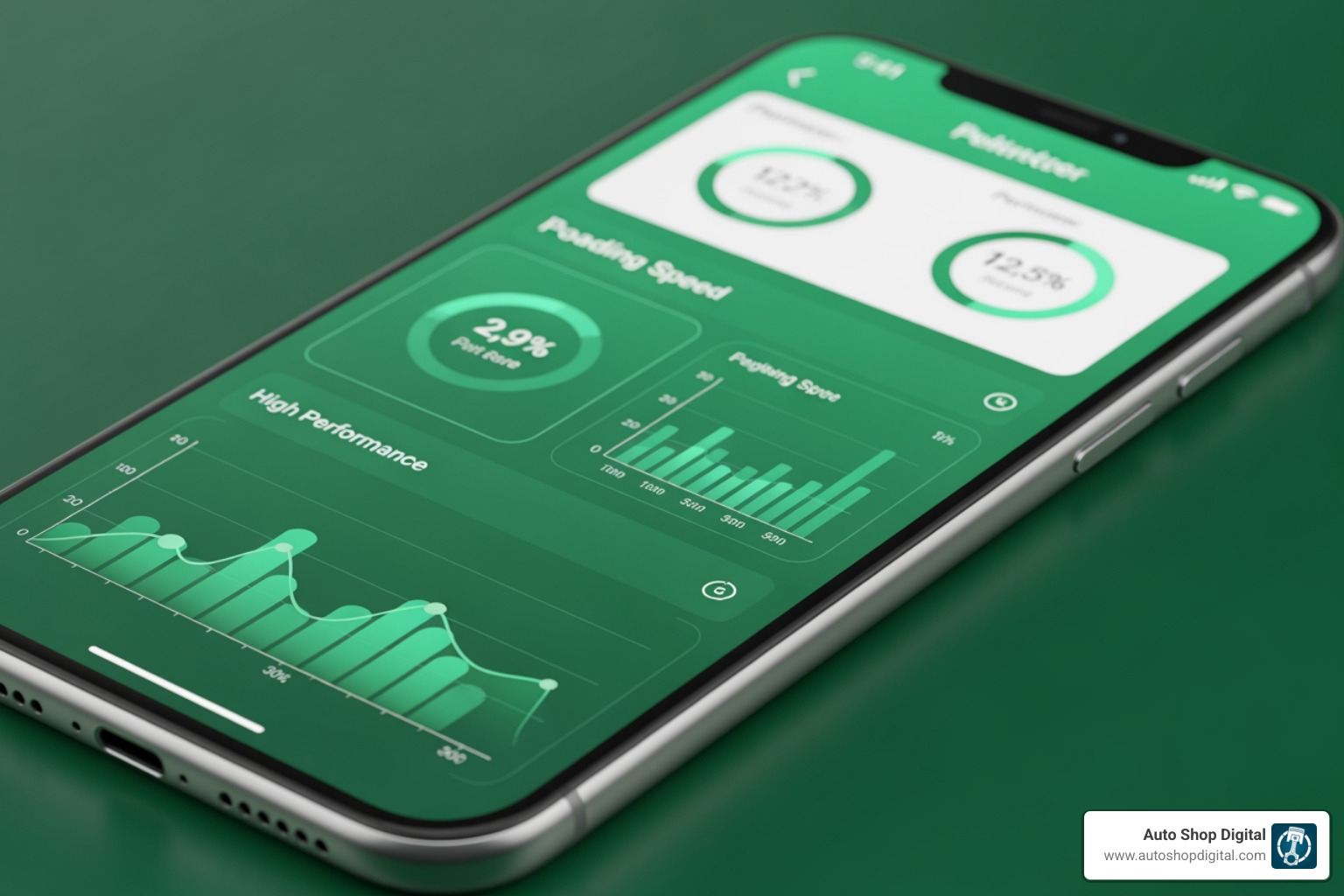
Google's Core Web Vitals measure page experience, tracking load speed, interactivity, and visual stability. Since over 60% of searches are mobile, Google primarily evaluates your mobile site for ranking. A clunky or slow mobile experience makes you invisible to most potential customers in Long Beach or Beverly Hills.
Beyond speed, your site needs a clean navigation structure and HTTPS security. A "Not Secure" warning in a browser erodes trust with both customers and Google. For a deeper dive, Technical SEO explained by Yoast is a great resource.
Implementing AI-Friendly Technical Optimizations
Optimizing for AI means making your content machine-readable. Technical SEO gives AI the context it needs to understand your site.
- Schema Markup: This is structured data in your site's code that acts as a translator for AI. Using the vocabulary from Schema.org , you can explicitly label your business type, services, reviews, and hours. This helps AI confidently cite your shop for relevant queries.
- URL Structure:
Keep URLs simple and descriptive (e.g.,
yourshop.com/brake-repair-santa-monica). This tells users and AI what the page is about, unlike a generic URL likeyourshop.com/page?id=4789. - Title Tags and Meta Descriptions: Your title tag (under 60 characters) and meta description (150-160 characters) are your first impression in search results. Make them unique, compelling, and include relevant keywords.
- Header Tags (H1, H2, H3): These create a clear content hierarchy, like a table of contents for your page. This helps AI understand the structure and importance of your information.
Why Mobile Optimization is Non-Negotiable
If your website doesn't work perfectly on mobile, you're losing business. Most of your customers are searching on their phones. Google now measures site speed primarily on mobile, so a fast, responsive site is essential.
Responsive design ensures your site automatically adjusts to any screen size, keeping text readable and images scaled correctly. Fast loading times are critical, as users on mobile networks will leave if a site takes more than a few seconds to load.
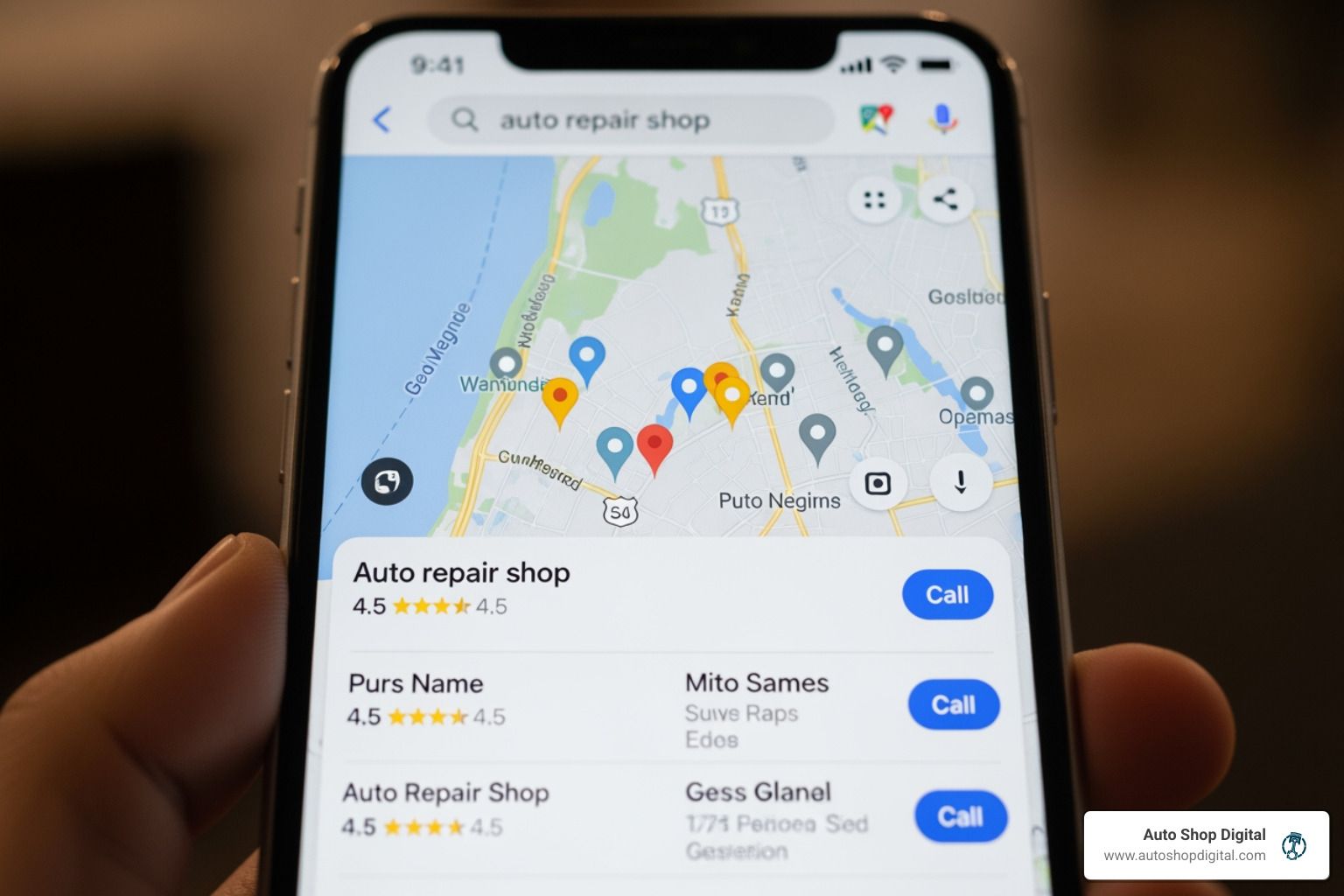
Buttons must be large enough to tap, and forms should be simple. Click-to-call functionality is one of the most important mobile features, allowing users to dial your shop with a single tap. For more tips, check out our guide on 7 Tips You Need for Designing a New Auto Shop Website.
From Browser to Bay: Mastering Conversion Rate Optimization (CRO)
Getting visitors to your site is only half the battle. Conversion Rate Optimization (CRO) is the process of turning those visitors into paying customers by guiding them from their first click to a scheduled appointment. For Automotive website optimization, this is where traffic turns into revenue.
Think of your website as a digital service advisor. It must greet customers, answer their questions, and make it easy for them to take the next step. A confusing or cluttered user experience (UX) will cause visitors to leave, especially mobile users who need quick answers.
The automotive industry's average conversion rate is just 2%, according to Ruler Analytics. This means 98 out of 100 visitors leave without taking action. While a good rate is 2-5%, we see this as a massive opportunity. Most shops are leaving money on the table because their websites don't effectively guide customers. Understanding the Online Consumers Thought Process is key to fixing this.
Key Elements for Driving Website Conversions
Converting visitors comes down to removing friction and building confidence. Every element should prompt the user's next step.
- Clear Calls-to-Action (CTAs): Buttons like "Schedule Service Online" or "Request a Quote" must be prominent and tell users exactly what to do.
- Live Chat: This feature offers instant answers to quick questions, converting hesitant visitors into leads, even after hours.
- Simple Forms: Only ask for essential information on contact and scheduling forms (e.g., name, phone, service needed). Every extra field reduces completion rates.
- Unique Selling Propositions: Showcase amenities like loaner cars, a comfortable waiting area, or ASE-certified technicians with high-quality photos to set yourself apart.
- Special Offers: Current promotions give customers a reason to act now. Feature them prominently on your homepage and service pages.
- Transparent Pricing: Displaying prices for common services builds immediate trust by eliminating uncertainty.
- Testimonials and Reviews: Integrating reviews on service pages provides powerful social proof and acts as a digital recommendation.
Measuring Your CRO Success
You can't improve what you don't measure. We use Google Analytics to track how visitors interact with your site.
First, we define what counts as a conversion. For auto shops, this includes form submissions, phone calls from click-to-call buttons, and online appointment bookings. Each action represents a potential customer.
Then, we watch key metrics to gauge performance. Bounce rate shows if visitors leave after one page. Time on page indicates engagement. Your conversion rate —the percentage of visitors who complete a goal—is the ultimate measure of success. While the industry benchmark is 2%, our goal is to optimize your site to reach or exceed the 2-5% range, turning more traffic into real business.
Frequently Asked Questions about Automotive Website Optimization
What are the immediate first steps to begin optimizing my auto shop website?
Start with three key actions:
- Analyze Your Performance: Set up the free Google Analytics and Google Search Console tools. They show you who visits your site and how they behave, revealing what's working and what isn't.
- Create Answer-First Content: Write one detailed page that answers a specific customer question, like "How Often Should I Replace My Brake Pads in Los Angeles?" Put the direct answer at the top. This targeted content attracts high-intent searchers.
- Audit Your NAP: Ensure your Name, Address, and Phone number (NAP) are identical across your website, Google Business Profile, Yelp, and all other online directories. Consistency is crucial for local Automotive website optimization and AI visibility.
How does website optimization for a service department differ from sales?
These two departments require different strategies. Most dealership traffic is for service, making those pages critical for lead generation.
- Service optimization is about trust and convenience. It requires online scheduling, transparent pricing, technician bios with certifications, and service-specific coupons. The goal is to answer, "Can I trust you, and can you make this easy?"
- Sales optimization is visual and informational. It focuses on high-quality inventory listings with photos/videos, virtual tours, and accessible financing tools like payment calculators. The goal is to answer, "Which car is right for me?"
While the technical foundation is the same for both, the user journey and content priorities are completely different.
How can I use AI tools like ChatGPT to improve my website?
AI tools can be powerful assets for improving your site, no technical expertise required.
- Audit Your AI Visibility: Ask ChatGPT or use Google's AI Overview for queries your customers use, like "best brake repair in Culver City." If your shop doesn't appear, you know where you need to improve.
- Analyze Your Content: Paste your service page text into ChatGPT and ask it to identify areas for improvement. Ask, "Is this content clear? Does it answer the customer's question directly?"
- Generate Content Ideas: Use AI to brainstorm blog post topics or create an outline for an FAQ page. For example, ask for "10 frequently asked questions about tire rotation." You can then customize the content with your shop's local expertise.
- Understand Technical Concepts: Ask AI to explain concepts like Schema markup. It can provide clear explanations and examples, acting as a helpful research assistant.
AI tools are not a replacement for human expertise, but they are excellent for research, identifying content gaps, and understanding how AI search perceives your business.
Conclusion
Automotive website optimization is changing. The shift from traditional SEO to Generative Engine Optimization (GEO) is fundamentally altering how customers find and choose auto shops.
Your website is no longer a static digital business card. It's your digital showroom, your most tireless salesperson, and the central hub of your marketing. It must be fast, clear, and designed to answer customer questions proactively.
Success in today's AI-driven landscape depends on four pillars: creating answer-first content, building E.E.A.T.(Experience, Expertise, Authoritativeness, and Trustworthiness), ensuring a rock-solid technical foundation, and mastering Conversion Rate Optimization to turn clicks into customers.
The AI revolution is here. Customers in Los Angeles, Santa Monica, and across California are asking AI tools for recommendations. If your website isn't optimized for this new reality, you're invisible to a growing segment of high-intent buyers.
At Auto Shop Digital, we specialize in helping independent auto shops compete with the big chains. We know you're passionate about cars, not digital marketing. That's why we provide turn-key Managed SEO and Google Business Profile optimization services to handle this complexity for you. With our 90-day performance promise and no set-up fees, we manage the technical details and content strategy so you can focus on running your shop.
Don't let the complexity of AI-driven search overwhelm you. The shops that adapt now will thrive. Let us help you Develop your comprehensive Automotive Digital Marketing Strategy and transform your website into a revenue-generating asset that works for you 24/7.
Start growing your shop business now!
Generate significant business growth with a Managed SEO service for your auto shop from Auto Shop Digital.