From Idea to Income: A Practical Guide to Maintenance Business Planning
Why Every Maintenance Business Needs a Solid Business Plan
A business plan for maintenance services pdf is your roadmap from startup idea to profitable operation. Whether you're launching an auto repair shop, home maintenance service, or commercial facility management company, a structured plan helps you:
- Secure funding from banks, investors, or the SBA
- Guide daily operations with clear processes and staffing plans
- Forecast finances including startup costs, revenue projections, and break-even analysis
- Define your market by identifying target customers and competitive advantages
- Set measurable goals for growth and profitability
The maintenance services industry is massive—the US home improvement market alone was valued at $537.9 billion in 2021 —but launching without a plan is like driving without a map. A comprehensive business plan addresses everything from your mission statement and pricing strategy to equipment needs and customer retention tactics.
I'm Daniel Harman, and as founder of Auto Shop Digital, I've spent over 15 years helping service businesses translate their operations into winning strategies, including developing comprehensive frameworks for a business plan for maintenance services pdf. This guide walks you through each essential section, so you can create a plan that attracts investors and keeps your business on track.
Section 1: Laying the Foundation - Company Overview & Services
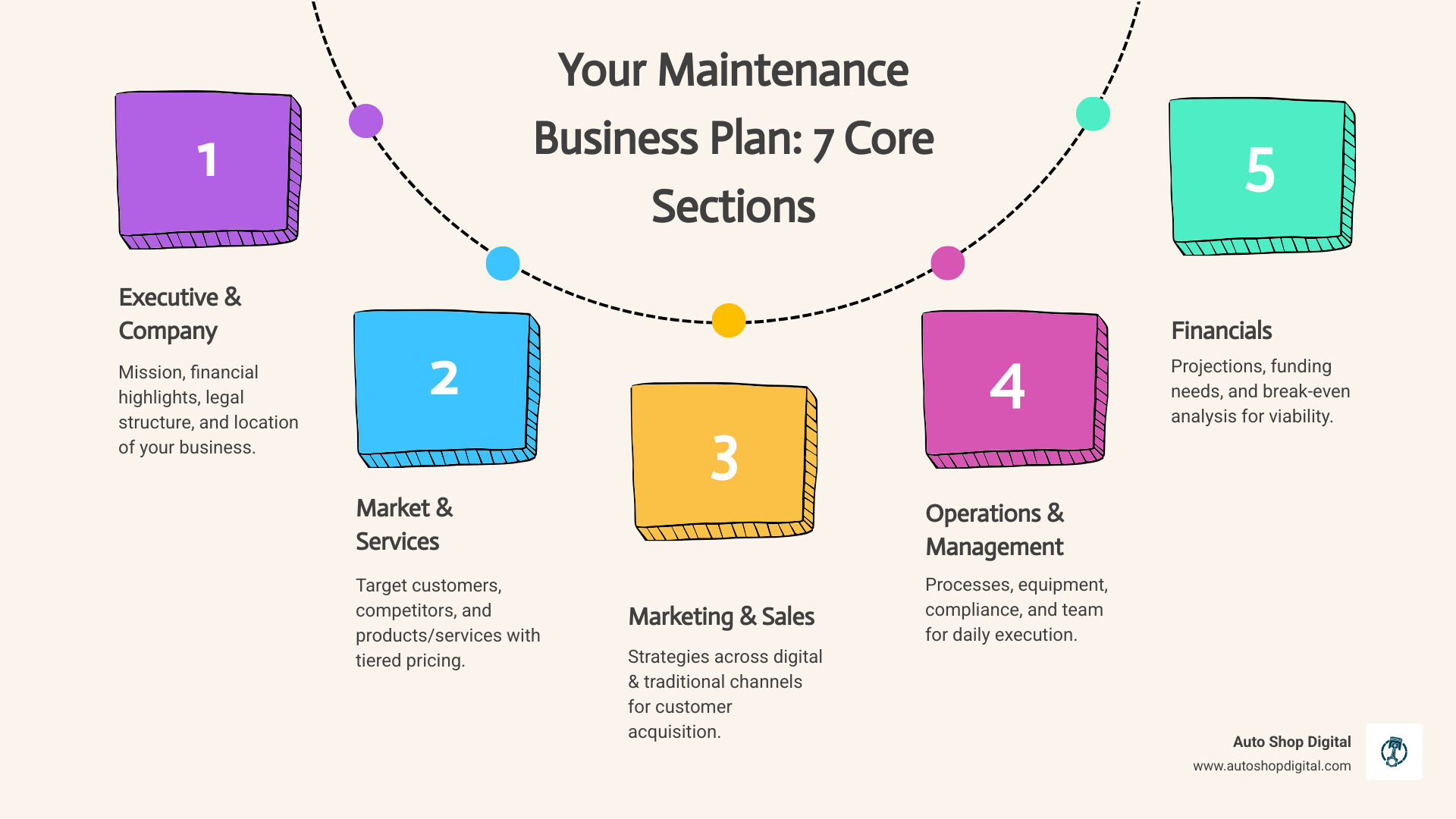
This section establishes your business's identity and purpose, forming the core of your plan. It tells investors and partners who you are and what you stand for. It’s the handshake, the first impression, and the narrative that defines your maintenance services company.

Company Description and Mission Statement
First things first, what's your company's name? Will you operate as a sole proprietorship, an LLC, or another legal structure? This decision impacts everything from liability to taxation, so choose wisely. Your location is also key; for us, our operations are rooted in sunny California, serving communities like Los Angeles, Santa Monica, Marina del Rey, Venice Beach, Beverly Hills, Culver City, Brentwood, and Long Beach.
Your mission statement is more than just a catchy phrase; it's the heart and soul of your business. It should be memorable, clear, and brief, outlining your core purpose and values. For instance, if we were creating a Building Maintenance Company Business Plan , our mission might focus on delivering reliable, high-quality maintenance solutions that improve property value and customer satisfaction. This statement guides your decisions, inspires your team, and communicates your commitment to clients. It answers the crucial question: why do we exist?
Defining Your Products and Services
Now, let's talk about what you actually do. This section of your business plan for maintenance services pdf needs to clearly describe your offerings. What kind of maintenance services will you provide?
Here’s a list of potential maintenance services to get your gears turning:
- General Maintenance: Handyman services, routine property checks, minor repairs.
- Specialized Services: HVAC maintenance, plumbing repairs, electrical system checks, or even auto repair services. For auto shops, this could include everything from oil changes to complex diagnostics. You can find more info about auto repair services to help define your offerings.
- Tiered Service Packages: Think bronze, silver, and gold plans! Offering different levels of service allows you to cater to diverse client needs and budgets.
- Subscription Models: Many clients appreciate the predictability of a monthly or annual subscription for ongoing maintenance, reducing their hassle and providing you with recurring revenue.
- One-Time Services: For those unexpected emergencies or specific projects.
Beyond just listing services, describe them in detail. What's included? What's your process for delivery? And crucially, how do you ensure quality? Quality assurance isn't just about fixing things; it's about building trust. For instance, in auto repair, it's about using certified parts and skilled technicians, backed by guarantees. For facility maintenance, it could involve detailed checklists and post-service inspections.
Section 2: Charting the Course - Market, Marketing, and Sales Strategy
Understanding your battlefield is crucial. This section analyzes the market you're entering and details how you'll attract and retain customers. It’s where you prove that there's a real demand for your maintenance services and that you know how to capture it.

Market Analysis and Target Audience
Before you can sell a single service, you need to know who you're selling to. Your market analysis is a deep dive into the industry landscape.
- Market Size and Growth: The US home improvement market is huge, offering plenty of opportunities. How big is your specific niche within this? Is it growing?
- Identifying Your Target Market:
Who are your ideal clients?
- Residential: Homeowners in affluent areas like Beverly Hills or Brentwood, who might be willing to pay a premium for quality and convenience.
- Commercial: Businesses in busy areas like Downtown Long Beach or Santa Monica, requiring regular upkeep for their offices or retail spaces.
- B2B (Business-to-Business): Partnering with property management companies, real estate agencies, or even other service providers who need reliable maintenance subcontractors.
- For an auto repair shop, your target audience could be busy professionals and families who value convenience and reliable service. Think about how to run a successful auto repair shop by focusing on these segments.
- Customer Demographics: What are their needs, pain points, and willingness to pay? Understanding these helps you tailor your services and marketing messages.
- Competitive Landscape Analysis: Who are your competitors in Los Angeles, Culver City, or Marina del Rey? What are their strengths and weaknesses? Do they offer comprehensive remodeling, modern tech-integrated solutions, or traditional craftsmanship? Identifying their weaknesses allows you to carve out your niche.
- Market Trends: Are there specific trends impacting maintenance services in California? Look for things like sustainability, demand for smart home integration, or the increasing use of technology for scheduling and diagnostics.
Unique Selling Proposition (USP) and Pricing
What makes your maintenance service special? Your Unique Selling Proposition (USP) is what sets you apart from the crowd. It’s why customers should choose you over anyone else.
- Differentiating Your Business: Do you offer a proactive maintenance approach, using IoT-enabled sensors for predictive maintenance, as seen in some elevator maintenance examples? Or perhaps you focus on speed and convenience, like a mobile mechanic service that comes to the client?
- Technology Integration: Leverage scheduling software, diagnostic tools, or even a mobile app for service booking. This not only streamlines your operations but also impresses tech-savvy clients.
- Eco-Friendly Practices: In environmentally conscious areas like Santa Monica or Brentwood, using eco-friendly cleaning products or sustainable methods can be a powerful differentiator.
- Pricing Strategy:
How will you charge for your services?
- Hourly: Simple for smaller jobs.
- Flat-Rate: Provides predictability for clients, especially for common services.
- Contract-Based: Ideal for recurring maintenance, offering stability for both parties. Our transparent pricing philosophy means we strive to be upfront and fair with all our clients.
- Justifying Premium Pricing: If you offer superior service, advanced technology, or specialized expertise, don't be afraid to charge accordingly. Clearly articulate the value you provide, whether it's extended equipment lifespan, reduced downtime, or peace of mind.
Marketing and Sales Strategies
Even the best maintenance service won't succeed if no one knows about it. Your marketing and sales strategies are how you spread the word and convert interest into income.
Here's a list of marketing channels to consider for your maintenance business:
- Digital Marketing:
This is non-negotiable in today's world.
- Automotive digital marketing strategy is key for auto repair shops.
- SEO for local search: Ensure your business appears when someone searches for "auto repair near me" in Long Beach or "HVAC maintenance Los Angeles." Local SEO is critical.
- Website: A professional online presence is vital. Why your auto shop needs a modern professional website outlines the benefits of a strong website.
- Social Media Marketing: Platforms like Facebook and Instagram are great for engaging with local communities. Use our Facebook tips to get started!
- Email Marketing: Build a list and send out promotions, maintenance tips, or service reminders.
- Google Ads: For auto shops, Google Ads can be the fastest way to reach "in the market" consumers actively searching for your services.
- Traditional Marketing:
Don't discount tried-and-true methods.
- Flyers and Local Ads: Especially effective in specific neighborhoods or for grand openings.
- Partnerships: Collaborate with local real estate agents, property managers, or auto dealerships.
- Vehicle Signage: Your service vehicles are mobile billboards!
- Sales Process: How do you convert leads into paying customers? This might involve providing detailed quotes, offering consultations, and clearly explaining your service contracts.
- Customer Retention Strategies: It's often cheaper to keep an existing customer than to acquire a new one. Loyalty programs, annual maintenance discounts, and personalized service are crucial. For auto repair, this could be automated service reminders or special offers for repeat clients. Exceptional customer service and quality work are the bedrock of retention, ensuring clients in Santa Monica or Venice Beach keep coming back.
Section 3: Building the Engine - Operations and Management Plan
This is the "how-to" section of your plan. It details the daily operations, the team that will execute them, and the processes that ensure quality and compliance. Think of it as the instruction manual for running your business.
Operational Plan: Processes and Equipment
Every successful maintenance business runs on efficient processes. This section outlines your daily workflow and how you'll deliver consistent, high-quality service.
- Daily Workflow: From receiving a service request to completing the job and following up, detail each step.
- Job Scheduling and Dispatching: How will you manage appointments and dispatch your team effectively across busy areas like Los Angeles or Long Beach? Scheduling software can be a lifesaver here.
- Customer Service Process: What happens when a customer calls with a question or a concern? How do you handle complaints? A clear process ensures customer satisfaction and builds loyalty.
- Supply Chain Management: Where will you source your parts and materials? For auto repair, this means reliable suppliers for quality parts. For facility maintenance, it means having access to the right cleaning supplies or specialized components.
- Required Equipment and Tools: List every tool, piece of machinery, and diagnostic device you'll need. This could range from wrenches and hoists for an auto shop to specialized HVAC equipment or pressure washers for facility maintenance.
- Vehicle Fleet: How many vehicles will you need? What type? How will they be maintained themselves?
- Safety Protocols: Maintenance work often involves risks. Outline your safety procedures, including personal protective equipment (PPE), hazard communication, and emergency response plans. Safety isn't just good practice; it protects your team and your business.
- Regulatory Compliance: This is paramount. For any business operating in California, you'll need to be aware of and comply with local, state, and federal regulations. For example, local planning and building departments, like those in santamonica.gov , have specific guidelines and requirements that might impact facility maintenance work. Ensure you have all necessary licenses and permits for your specific services.
Management Team and Staffing
Your team is your greatest asset. This section introduces the people who will make your maintenance business a success.
- Founders' Experience: What unique skills and experience do you bring to the table? Highlight your background in maintenance, business management, or customer service.
- Key Managers' Roles and Responsibilities: If you have a larger team, define who does what. Who is responsible for operations, who handles marketing, and who oversees finances?
- Organizational Chart: A visual representation of your company structure, showing reporting lines and decision-making hierarchy.
- Staffing Needs: How many technicians, administrative staff, or customer service representatives will you need initially and as you grow?
- Hiring and Training Plan: How will you attract qualified talent in competitive markets like Los Angeles? What training will you provide to ensure your team is skilled, professional, and up-to-date with the latest techniques and safety protocols? A continuous learning system helps build trust and exceed client expectations.
- Compensation and Benefits: Outline your wage structure, benefits, and any incentive programs. Competitive compensation helps attract and retain top talent.
Section 4: The Financial Blueprint: Crafting Your Business Plan for Maintenance Services PDF
Numbers tell the story of your business's viability. This section provides a comprehensive financial overview, crucial for securing loans and tracking performance. This is where your dream meets reality, proving that your maintenance service can not only survive but thrive.
Key Financial Projections
This is the part that makes investors sit up and take notice. Your financial projections should cover at least three to five years and include detailed statements.
- Sales Forecast: Project your revenue based on your services, pricing, and market analysis. Be realistic but confident. For an auto repair shop, this would include anticipated car counts and average repair order values.
- Profit and Loss (P&L) Statement: This shows your revenue, cost of goods sold (COGS), operating expenses, and ultimately, your net profit or loss. It's a snapshot of your profitability.
- Cash Flow Statement: Crucial for understanding how cash moves in and out of your business. It ensures you have enough liquidity to cover expenses and seize opportunities.
- Balance Sheet: This provides a picture of your assets (what you own), liabilities (what you owe), and equity (your ownership stake) at a specific point in time.
Here's a table showing a sample 3-year projection for revenue, cost of goods sold, and net profit:
| Category | Year 1 | Year 2 | Year 3 |
|---|---|---|---|
| Revenue | $178,970 | $250,558 | $350,781 |
| Cost of Goods Sold | $50,000 | $70,000 | $98,000 |
| Gross Profit | $128,970 | $180,558 | $252,781 |
| Operating Expenses | $97,176 | $136,046 | $190,464 |
| Net Profit | $31,794 | $44,512 | $62,317 |
(Note: These figures are illustrative and should be replaced with your specific, well-researched projections.)
Funding Request and Break-Even Analysis for your business plan for maintenance services pdf
Unless you're blessed with an endless supply of cash (and who isn't?), you'll likely need funding. This section outlines your financial needs and how you plan to use the money.
- Startup Costs: Detail all initial expenses. This includes equipment and tools, vehicle purchases, initial inventory, insurance, marketing campaigns, legal fees, and working capital. For an auto repair shop, this could involve significant investment in lifts, diagnostic equipment, and a suitable commercial space.
- Working Capital: The cash you need to cover day-to-day operations until your revenue consistently exceeds your expenses.
- Total Funding Needed: Sum up all your startup costs and working capital requirements.
- Sources of Funds: Where will this money come from? Owner's equity, bank loans, angel investors, or perhaps grants?
- Uses of Funds: Clearly explain how every dollar will be spent. This demonstrates fiscal responsibility and helps investors understand their return potential.
- Break-Even Analysis Calculation: This critical calculation determines the point at which your total revenue equals your total costs, meaning you're neither making a profit nor incurring a loss. Knowing your break-even point helps you set sales targets and understand your business's financial viability. For example, if your monthly fixed costs are $10,000 and your average profit per service is $50, you need to perform 200 services to break even.
Frequently Asked Questions about Maintenance Business Plans
What are the essential components of a business plan for maintenance services?
A complete business plan for maintenance services pdf includes an Executive Summary (your elevator pitch), a detailed Company Overview, thorough Market Analysis, a clear description of Services Offered, a strategic Marketing & Sales Plan, a practical Operations Plan, an experienced Management Team section, and a comprehensive Financial Plan. These components collectively provide a holistic view of your business, its potential, and its operational strategy.
How do I make my business plan stand out?
To make your business plan truly shine, focus on several key areas. First, clearly articulate a compelling Unique Selling Proposition (USP) that differentiates your services. Perhaps you offer rapid response times in congested areas like Los Angeles, or specialize in eco-friendly solutions for facilities in Brentwood. Second, demonstrate a deep, data-driven understanding of your target market in your specific California locations, showing you know your potential customers' needs and how to reach them. Third, provide realistic and well-researched financial projections, backed by solid assumptions. Lastly, highlight the expertise and experience of your management team, proving you have the right people to execute your vision.
Where can I find a sample business plan for maintenance services pdf?
Many resources are available online to help you visualize the structure and depth required for a professional business plan. While we've discussed general principles, reviewing a specific example can be incredibly helpful. For example, you can review this sample cleaning service business plan to understand the structure and level of detail required. That while these templates provide a framework, you'll need to customize them with details specific to your unique maintenance services, target market, and operational nuances in your California location.
Conclusion: Turning Your Plan into Profit
A well-crafted business plan is your roadmap to success. It transforms your idea into an actionable strategy, guiding you through launch and growth. By detailing your mission, market, operations, and financials, you create a powerful tool for attracting investment and managing your business effectively. It's not just a document; it's a living guide that you'll revisit and refine as your business evolves.
Once your plan is in place and you're ready to attract customers, a targeted marketing strategy is your next critical step. Auto Shop Digital specializes in creating and executing auto repair marketing plans that drive real results, letting you focus on what you do best—running your shop. We're here to help auto repair shops in Los Angeles, Santa Monica, Marina del Rey, Venice Beach, Beverly Hills, Culver City, Brentwood, and Long Beach steer the digital landscape, ensuring your hard-earned business plan translates into measurable success and a steady stream of satisfied customers.
Start growing your shop business now!
Generate significant business growth with a Managed SEO service for your auto shop from Auto Shop Digital.