> **TL;DR:** Car dealership advertising in 2026 is a full-funnel, omnichannel system — not a single campaign. Digital ad conversions at dealerships jumped 37.3% year-over-year while cost per lead dropped 14.8%. Winning dealers combine paid search, Google Vehicle Listing Ads, Meta Automotive Inventory Ads, video, email, and [local SEO](/services/managed-local-seo). Every channel should be tracked to cost per sale. Independent auto shops can apply the same principles — focused on services instead of VINs — to compete effectively against larger competitors.
The way people buy cars has changed. The way dealerships advertise needs to change with it. With 92% of car buyers researching online before purchasing a vehicle, the old playbook of radio spots and newspaper inserts no longer carries the weight it once did. This guide breaks down what actually works in car dealership advertising right now, with practical steps for both franchise dealers and independent auto shops.
## Key Takeaways.
2026 is a pivotal year for car dealership advertising. Digital ad conversions at dealerships jumped 37.3% year-over-year while cost per lead dropped 14.8%, according to Fullpath's Auto Intelligence Index. At the same time, AI-driven search is reshaping how vehicle shoppers discover dealers, and rising competition is pushing ad costs higher on legacy channels. Dealers who adapt will pull ahead; those who don't will waste budget chasing yesterday's results.
* Winning car dealers combine paid search, social media ads, video ads, and [local SEO](/services/managed-local-seo) rather than relying on a single channel.
* Control your ad spend with VIN-level or campaign-level tracking. "Set it and forget it" budgets lead to overspending on underperforming models and channels.
* Digital marketing fundamentals — a fast website, strong local search presence, and consistent review generation — still drive most leads and deserve priority before layering on advanced tactics.
* Localized, omnichannel digital strategies attract more customers to dealerships of every size.
* Independent auto businesses and service departments can apply these same marketing strategies. Auto Shop Digital specializes in helping independent shops compete using data-driven advertising, managed SEO, and conversion-focused websites.
## What Is Car Dealership Advertising in 2026?
Car dealership advertising is the mix of paid and organic tactics used to sell vehicles and service across Google, Meta, YouTube, TikTok, email, and local search. It's no longer about running a single promotion — it's a full-funnel system designed to reach car shoppers at every stage.
Modern car dealership marketing strategies must touch the entire buyer journey:
* **Early stage:** Model research like "best SUV for families," financing options, comparisons of new cars and used cars.
* **Mid-stage:** Inventory discovery, "Toyota dealer near me" searches, trade-in estimates.
* **Late stage:** Post-sale service offers, service reminders, loyalty programs.
The main channels include search ads (including Google Vehicle Listing Ads), social inventory ads (Meta AIAs), video content, email campaigns, and SEO with local SEO. The difference between dealership marketing as a system and individual advertising tactics is critical — random promotions burn budget, while a connected strategy compounds results.
Independent service and repair shops can mirror many of these tactics. [Auto Shop Digital's managed local SEO service](/services/managed-local-seo) acts as a specialist partner for in-house teams that lack the time or expertise to execute digital marketing at this level.
## Building a Dealership Marketing Strategy: Step-by-Step.
Random ads waste ad spend. A structured strategy increases lead volume and lowers cost per sale. Here's how to build one:
1. **Define ideal customers:** Segment by new vs. used, finance vs. cash, high-margin models vs. volume, and service vs. sales.
2. **Map their digital journey:** Identify which channels and content each segment needs at awareness, consideration, purchase, and retention stages.
3. **Pick channels:** Match audience behaviors to platforms — search engines for high-intent, social media for awareness, email for retention.
4. **Set budget per channel:** Dealerships average roughly $543,000 annually in advertising, often about 6–7% of gross profit. Small single-franchise dealers might spend tens of thousands per month; mid-size dealers $50K–$200K monthly.
5. **Define KPIs:** Cost per lead, cost per sale, VDP views, days-on-lot, and service appointment volume.
Even if campaigns are run in-house, schedule monthly reviews of performance and reallocate budget quickly based on results. Every marketing dollar should be traceable.
## Paid Search Fundamentals: Branded, "Near Me," and High-Intent Campaigns.
[Google Ads](/services/managed-google-ads) remain the backbone of digital car dealership marketing, especially for in-market shoppers searching in specific demographics and zip codes. Using location-specific wording boosts Google indexing for local searches, so ad copy should emphasize your city and neighborhood.
Branded search campaigns — bidding on your dealership name — protect website traffic from competitors and listing aggregators. "Near me" terms like "Chevy dealer near me" and "used trucks near me" are critical for buyers ready to visit a lot. Structure campaigns by intent:
* **Branded:** Your dealership name and variations.
* **Near-me / geo-modifier:** "[Make] dealer near me," "[City] used cars."
* **Inventory/model-specific:** "2024 Honda CR-V lease," "used F-150 under 40k."
* **Service keywords:** "oil changes near me," "brake repair [city]."
Ad copy should highlight local relevance, inventory availability, and clear special deals. Use location extensions and call extensions during open hours so potential customers can reach you immediately. Geofencing ads can double click-through rates compared to non-targeted ads, making hyper-local targeting especially worthwhile.
## Google Vehicle Listing Ads (VLAs) and Inventory Search.
VLAs are image-based inventory ads showing live vehicles, price, mileage, and dealer name at the top of Google search results. They target high-intent buyers searching for a specific vehicle.
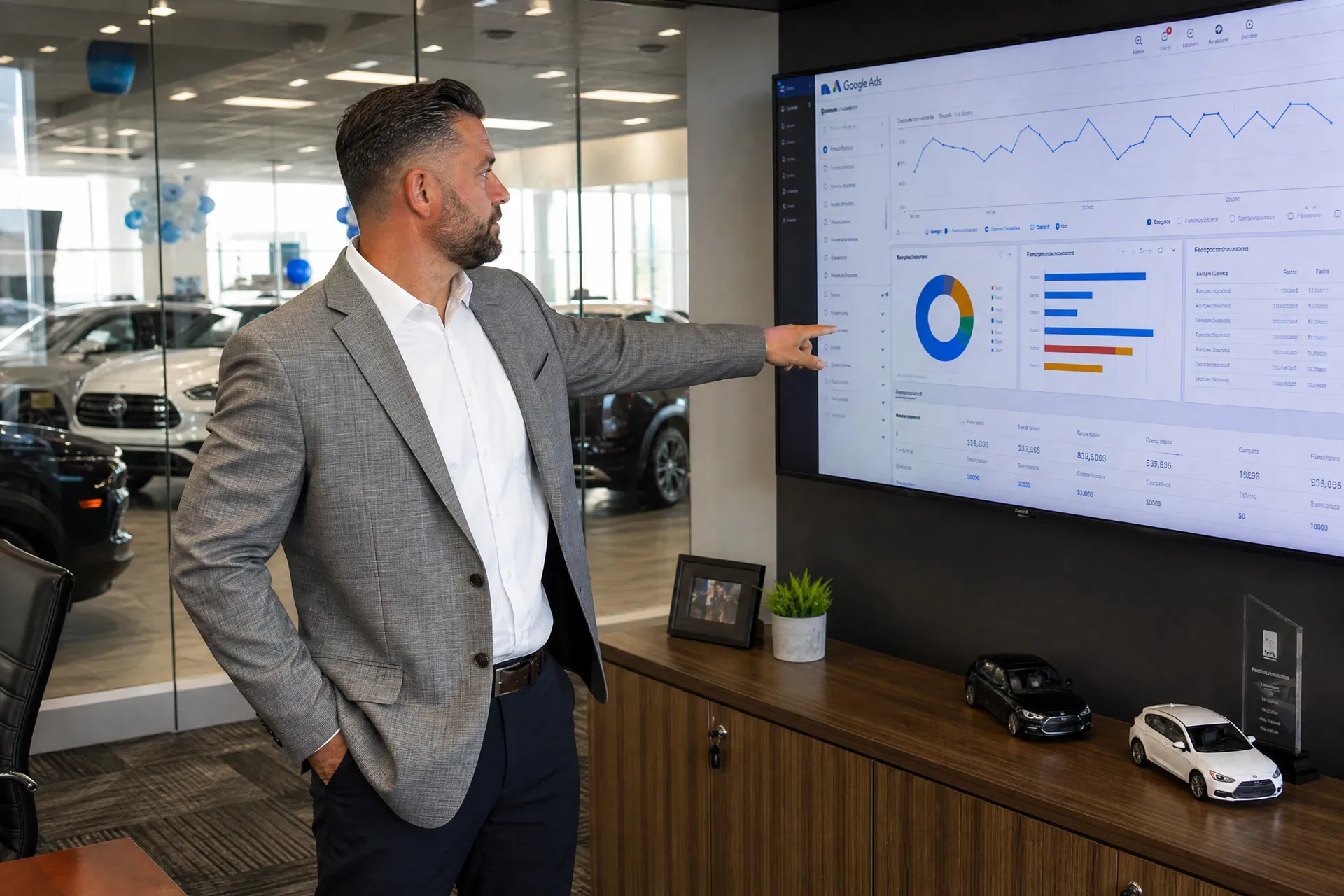
Prerequisites include an accurate inventory feed, compliant data fields (VIN, pricing, mileage), and a website with strong vehicle detail pages. VLAs convert well because they match queries like "used 2022 F-150 under 40k" with actual inventory, shortening research time. Demand Local reports VLAs deliver an average CTR of 8.29% and conversion rates around 7.76%, with top dealers reaching 15–20%. They also produce roughly 67% lower cost-per-click than standard search ads.
Monitor which models and price ranges perform best and adjust stock and ad budgets accordingly. For service-focused auto shops that can't use VLAs, a similar approach works through schema markup and structured service content to surface in local and AI-powered search results.
## Social Inventory Ads: Meta Automotive Inventory Ads (AIAs).
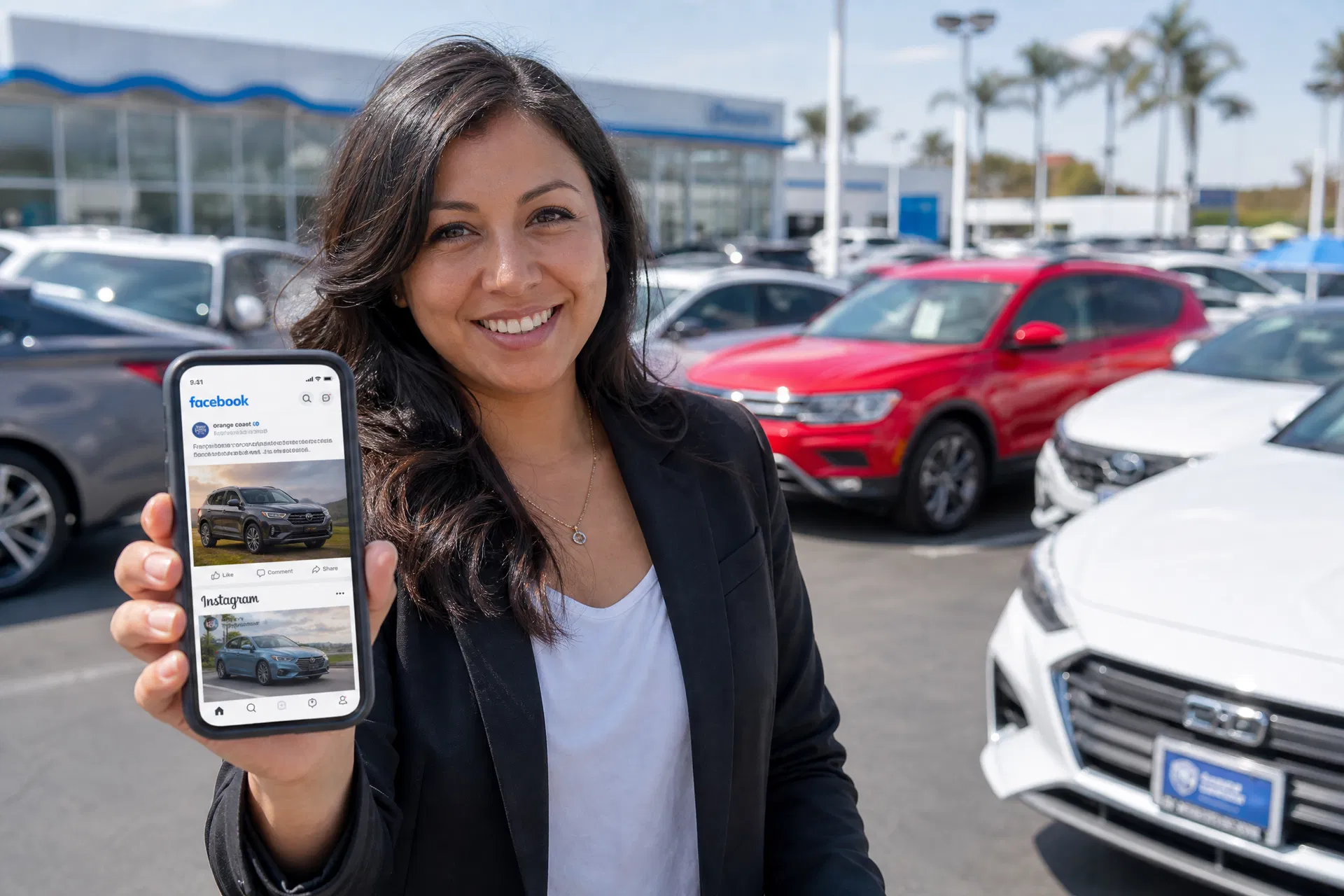
Facebook and Instagram Automotive Inventory Ads automatically pull from the dealership's vehicle feed to create dynamic social media ads. This format is especially powerful for lots with 150–300+ units but can still benefit smaller car dealers if feeds are accurate and well-maintained. AIAs retarget website visitors with the exact vehicles they viewed or similar options, lowering cost per lead. Research shows 21% of car buyers say social media influenced their purchase.
Creative best practices for social media marketing with AIAs:
* Clean vehicle photos, no cluttered backgrounds.
* Clear monthly payments or price ranges.
* Local language and dealership services highlighted.
* Strong calls to action: "Schedule a test drive," "See this vehicle."
Auto Shop Digital uses comparable dynamic-ad approaches for independent repair and tire shops, focused on services instead of VINs. See our guide to [advertising channels for auto shops](/blog/what-advertising-channels-should-your-auto-shop-use) for a full breakdown.
## Video and Short-Form Content: YouTube, TikTok, and Reels.
Car shoppers now spend significant time researching vehicles through video before visiting a dealership. In fact, 91% of people watch videos to learn about products, making video content a non-negotiable channel. YouTube pre-roll and in-stream ads work for awareness: walkarounds, "why buy here" stories, and seasonal offers targeted by geography and in-market signals. According to Innovid's 2026 outlook, 86% of auto marketers plan to increase CTV and digital video spend this year.
TikTok, Instagram Reels, and YouTube Shorts are ideal for lightweight, frequent content: new arrivals, behind-the-scenes footage, quick feature demos, and service tips. Keep short-form videos under sixty seconds for effectiveness. Walkaround videos increase engagement on vehicle detail pages. Shoot vertically for short-form and horizontally for YouTube, with clear on-screen text for offers. Post at a consistent weekly cadence rather than chasing viral hits. Independent auto shops can reuse service-focused videos for content marketing that builds local reach. See our [car dealership video marketing guide](/blog/car-dealership-video-marketing) for more detail.
## Retargeting That Actually Converts.
Retargeting campaigns bring back visitors who viewed inventory, service pages, or trade-in tools but didn't convert. Best practices include:
* Dynamic creative showing the vehicle or service viewed, plus incentives like limited-time APR, trade bonuses, or free inspections.
* Segmented audiences: Recent VDP viewers, finance page visitors, service customers, and trade-in tool users each get tailored messaging.
* Hyper-targeted ads improve lead generation by speaking directly to demonstrated interest.
Avoid generic "visit our dealership" banners that ignore the user's past behavior — they waste impressions. Even small independent shops can run simple retargeting focused on services like brakes, tires, and maintenance packages.
## Payment-Based and Special Finance Advertising.
Many vehicle shoppers in 2026 shop by monthly payment rather than MSRP, especially for used cars in markets with rising interest rates. Frame ads around payments: "Drive a 2023 Camry for $389/mo with $0 down," ensuring legal disclaimers and lender compliance are visible.
Special finance campaigns can target credit-challenged buyers with honest messaging about what credit tiers the dealership can help. Dealership advertising must accurately reflect inventory and pricing — misaligned offers create friction in the showroom and erode trust.
For auto repair shops, a parallel approach works: financing for large repairs, buy-now-pay-later options, or maintenance memberships advertised with clear terms.
## Leveraging Email Marketing and CRM Data.
Email marketing yields a $36 return for every $1 spent, making it one of the highest-ROI channels for nurturing both sales and service customers at low incremental cost. Essential email campaigns include:
* **New inventory alerts** — drive showroom visits and sell more cars.
* **Lease/finance expiration reminders** — retention and upgrades.
* **Service due notices** — service revenue and loyalty.
* **Seasonal service offers** — boost appointments.
* **Loyalty rewards** — repeat business.
Targeted email campaigns outperform generic monthly newsletters — segment by first-time buyers, off-lease customers, fleet accounts, and long-time service clients. Use behavior data from your CRM (pages visited, vehicles viewed, prior services) to personalize subject lines and offers. Independent auto shops can lean even more heavily on email campaigns to drive repeat visits.
## SEO, Local SEO, and AI-Driven "Answer Engines."
Car dealership marketing strategies must include organic visibility on search engines, Google Maps, and AI-driven tools like ChatGPT and Google AI Overviews. On-page SEO basics include optimized title tags, meta descriptions, internal linking, and content that answers specific vehicle and finance questions.
[Local SEO](/services/managed-local-seo): Google Business Profile optimization with accurate NAP, categories, photos, and weekly posts about new arrivals and promotions. Shops with 50+ reviews and weekly photo updates generate roughly 2.1× more direction requests. See our complete guide to [Google Business Profile optimization](/blog/google-business-profile-optimization) for step-by-step instructions.
Generative Engine Optimization (GEO): Write detailed, locally relevant content that AI tools can confidently quote — answer questions like "How much does a brake job cost in Phoenix?" with specifics. Auto Shop Digital specializes in [automotive local SEO](/blog/automotive-local-seo) and Google Business Profile management for independent auto repair shops, helping them rank in Maps and AI search for "[service] near me" queries.
## Review Generation and Reputation Advertising.
Reviews on Google, Facebook, and third-party sites often decide which dealership or auto shop gets the first call. Build a simple process: request reviews from every satisfied customer via text or email within 24 hours of delivery or service. Reuse 5-star reviews in ads, on landing pages, and in social posts to build trust and improve conversion rates. Respond publicly to both positive and negative reviews. Consistent reputation management supports both SEO (local rankings) and paid campaign performance by boosting click-through rate.
## Service Department Advertising and Service-to-Sales Pipelines.
Fixed operations — service, parts, body shop — provide more predictable revenue than vehicle sales, making service advertising critical. Most dealerships underinvest here. Promote oil changes, tire rotations, and seasonal packages with dedicated search ads and social posts. Use service visits as a pipeline to more sales: equity mining, trade-in offers, and upgrade loyalty incentives based on mileage and payment history. Independent auto repair shops should treat their own service database the same way — nurturing long-term loyalty with reminders and VIP service offers.
## Trade-In and Instant Appraisal Campaigns.
Many buyers don't know their vehicle's current value and may be earlier in the buying cycle. Campaigns like "Find out what your car is worth in 60 seconds" or "We'll buy your car even if you don't buy from us" capture leads before competitors do. Route trade-in leads to dedicated landing pages with simple forms and clear next steps. For independent auto shops, similar language works for "free safety inspection" or "tire and brake check" campaigns to start value-based conversations.
## Community, Sponsorships, and Authentic Content.
Community involvement — sponsoring local sports teams, charities, and events — builds trust that pure advertising can't buy. Capture photos and short video at local events, then turn them into social posts, website stories, and lightweight ad campaigns. Feature staff and customers in content (with permission) — delivery photos, service milestones, and long-term customer stories. This style works especially well on Facebook, Instagram, and Google Business Profile photos and posts, expanding local reach organically. This is long-term brand building that supports performance campaigns — it doesn't replace them.
## Website Experience and Dedicated Landing Pages.
Every marketing dollar of digital advertising ultimately runs through the dealership's website, making UX and speed non-negotiable. Technical basics most dealers overlook:
* Fast load times (under 3 seconds).
* Strong mobile performance.
* Clear navigation between inventory, specials, finance, and service pages.
Build dedicated landing pages per campaign — trucks, EVs, lease specials, service coupons, special finance — to improve conversion rates. Include clear calls-to-action: "Schedule Test Drive," "Get Pre-Approved," "Book Service," and chat/text options for visitors who prefer not to call. Auto Shop Digital focuses on conversion-first websites for independent auto shops using similar principles tailored to services instead of inventory. See our [auto dealer website builder guide](/blog/auto-dealer-website-builder) for more.
## Bringing Marketing In-House vs. Partnering with a Specialist Agency.
Many car dealers and auto shop owners debate whether to build in-house marketing teams or rely on agencies. A hybrid model often works best: one in-house marketing coordinator supported by an [automotive-focused digital agency](/blog/automotive-advertising-agency) for SEO, paid search, and advanced reporting.
For independent repair, tire, and body shops that want expert-level SEO and web marketing without hiring a full internal team, Auto Shop Digital offers month-to-month contracts with no setup fees and a 90-day performance guarantee.
## Budgeting and Measuring Ad Spend ROI.
Dealership advertising budgets should be tied to clear revenue goals, not historical habits. Allocate by funnel stage:
* **Demand capture (search, VLAs):** Highest priority for most dealerships.
* **Demand creation (video, social):** Builds awareness and reaches more shoppers.
* **Retention (email, service ads):** Low cost, high lifetime value for service customers.
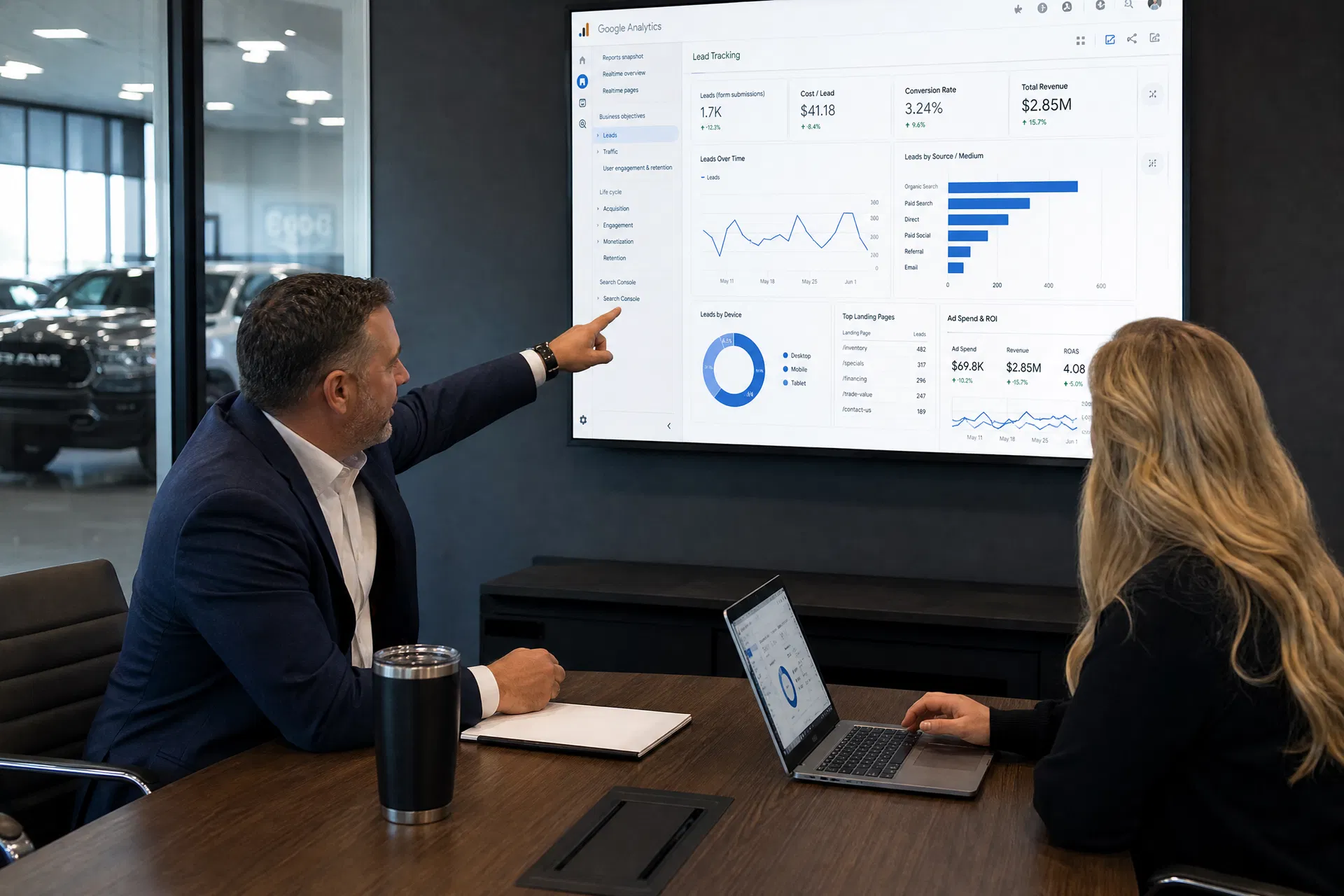
Track cost per VDP view, cost per lead, cost per sale, days-on-lot by model, and lifetime value for service customers. Review monthly and quarterly with clear rules for shifting spend away from underperforming channels. If you can't see leads and sales by channel, your budget is likely misallocated. See our guide to [automotive digital marketing strategy](/blog/automotive-digital-marketing-strategy) for a full measurement framework.
## Common Mistakes in Car Dealership Advertising.
Avoid these pitfalls whether you run a franchise or independent lot:
* Sending all ad traffic to the homepage instead of dedicated landing pages.
* Ignoring mobile visitors (most car shoppers browse on phones).
* Running generic creative that doesn't reference inventory, locality, or specific demographics.
* Stopping ads during strong sales months, assuming leads arrive on their own.
* Neglecting service department marketing and paying attention only to vehicle sales.
* Underusing email marketing and review generation.
* Failing to capture or follow up with leads promptly — timely follow-up is essential in converting interested shoppers.
* Outsourcing everything without transparency into where ad spend goes.
Quick-fix priority order: Start with tracking and lead routing, fix your key landing pages, build a review generation process, then layer on advanced tactics. Most dealerships that struggle are missing these basics.
## How Auto Shop Digital Helps Independent Auto Businesses Compete.
Auto Shop Digital isn't built for franchise car dealerships — we're built for independent auto repair, tire, and body shops that need the same caliber of digital marketing without the overhead. Core offerings include:
* [Managed SEO](/services/managed-local-seo) with keyword research, technical optimization, and content strategy.
* [Google Business Profile optimization](/services/managed-google-business-profile) and management.
* Content marketing and reputation management.
* Conversion-focused website design.
No setup fee, 90-day performance guarantee, month-to-month contracts, and minimal time required from you. We apply the same principles used by large car dealerships — data-driven advertising, strong local SEO content, and consistent digital marketing — scaled for your business. If you're ready to see how improved online visibility can increase calls and booked appointments, [request a free SEO audit](/seo-audit) and let's look at what's possible for your shop.
## FAQ: Car Dealership Advertising and Local Auto Marketing.
These FAQs address practical questions aimed at both car dealers and independent auto shop owners navigating digital advertising in 2026.
### How much should a car dealership spend on digital advertising in 2026?
Most franchise dealerships invest between 6–12% of gross profit on marketing, with the majority now going to digital channels. The national average sits around $543,000 annually, but your local market and competition matter more than any single number. Smaller independent dealers should start with a modest fixed monthly budget — even $5,000–$15,000 — and scale based on measured cost per sale. Split spend between demand capture channels (search, VLAs), demand creation (social, video), and retention (email and service campaigns). If you can't see leads and sales by channel, the budget is likely too high for your current level of tracking and control.
### Can a small independent auto shop really compete with big dealer advertising?
Absolutely — but not by trying to out-spend them. Small shops dominate specific local niches with strong SEO, well-optimized Google Business Profiles, and focused service campaigns targeting high-margin work. Service-based businesses win by ranking in Maps, collecting great reviews, and running targeted ads rather than broad awareness campaigns. Auto Shop Digital is built around this exact challenge — helping small, independent shops attract more local customers online efficiently. Start with a [strong local SEO foundation](/services/managed-local-seo), and a small but consistent monthly ad and email budget to build momentum.
### What's the most important first step if our dealership's marketing is a mess?
Start with an audit. List every current channel, login, budget line, and metric you have access to, then identify what's producing results and what has no clear ROI. Fix tracking and lead routing first — every call, form, chat, and email should be captured and attributed properly. Then prioritize one or two high-impact wins, like improving your [Google Ads search campaigns](/services/managed-google-ads) and updating your website's key landing pages, before adding more channels. Bringing in a specialist for even a one-time strategy engagement can save months of trial and error.
### How is AI changing car dealership advertising and SEO?
More shoppers now ask conversational questions in AI tools, which recommend local dealerships or auto shops based on trustworthy, detailed content. Dealers and shops need content that addresses specific questions — "How much does a brake job cost in Phoenix in 2026?" — with local detail, pricing ranges, and clear explanations. Structured data, FAQ pages, and well-maintained Google Business Profiles serve as building blocks for being included in AI-generated summaries. Auto Shop Digital already factors AI visibility into SEO content planning for independent shops, helping them show up where the customer experience is increasingly starting — inside an AI answer.
### Is it better to run everything in-house or hire multiple specialist vendors?
Multiple vendors can bring deep expertise per channel but often create data silos and mixed messaging, while in-house teams may lack time or specialized tools. Many successful operations use a blended approach: a small internal marketing point person plus one primary digital partner covering SEO, website, and core paid campaigns. Choose partners that offer clear reporting and flexible contracts so your dealership or shop can adapt as needs change. For independent auto shops with limited staff, an agency like Auto Shop Digital often replaces the need to hire full-time marketing employees — delivering expert-level results at a fraction of the cost with industry best practices built in.
Car Dealership Advertising: A Practical Guide to Smarter Ad Spend in 2026
By Daniel Harman•July 2026
Ready to Grow Your Auto Shop?
Turn Readers Into Customers
Our turn-key marketing services are built exclusively for auto repair shops. Pick the service that fits your goals and get started today.
Managed Local SEO
Rank higher on Google and Google Maps for 'auto repair near me' searches.
Google Business Profile
Dominate the Local Pack with a fully optimised Google Business Profile.
Google Ads
Get immediate leads with targeted PPC campaigns for auto repair keywords.
Website Design
A fast, SEO-optimised website built to convert visitors into booked jobs.
Related Articles
Marketing
Auto Dealership Marketing Solutions: A Complete 2026 Playbook
A complete 2026 guide to car dealership marketing — covering SEO, Google Ads, inventory-based campaigns, social media, fixed-ops marketing, and VIN-level attribution to lower cost per sale.
Read more
Marketing
Attract More Customers Online Without Complicated Web Design Hassles
An automotive web design agency builds websites that rank locally, convert on mobile, and fill your bays — not generic templates. See how specialized design drives real leads for auto shops.
Read more
Marketing
Auto Shop Digital vs. Autoshop Solutions: Which Automotive Marketing Agency Is Right for Your Shop?
Comparing Auto Shop Digital vs. Autoshop Solutions? See a side-by-side breakdown of pricing, setup fees, contract terms, SEO methodology, and performance guarantees to help you choose the right automotive marketing agency.
Read more