> **TL;DR:** To significantly boost customer traffic and revenue, your auto repair shop needs to appear in the Google Map Pack. This prominent section of Google's search results highlights local businesses, offering increased visibility and direct contact options for potential customers. Optimize your Google Business Profile, actively collect and manage customer reviews, and ensure consistent local citations to improve your chances of ranking.
## Introduction: What Is the Google Map Pack and Why Does It Matter?
The Google Map Pack is the single most important local search feature for auto repair shop owners and local business owners looking to attract more customers from their area. This guide explains what the Google Map Pack is, why it matters for auto repair shops, and step-by-step strategies to help your business appear in these top local search results.
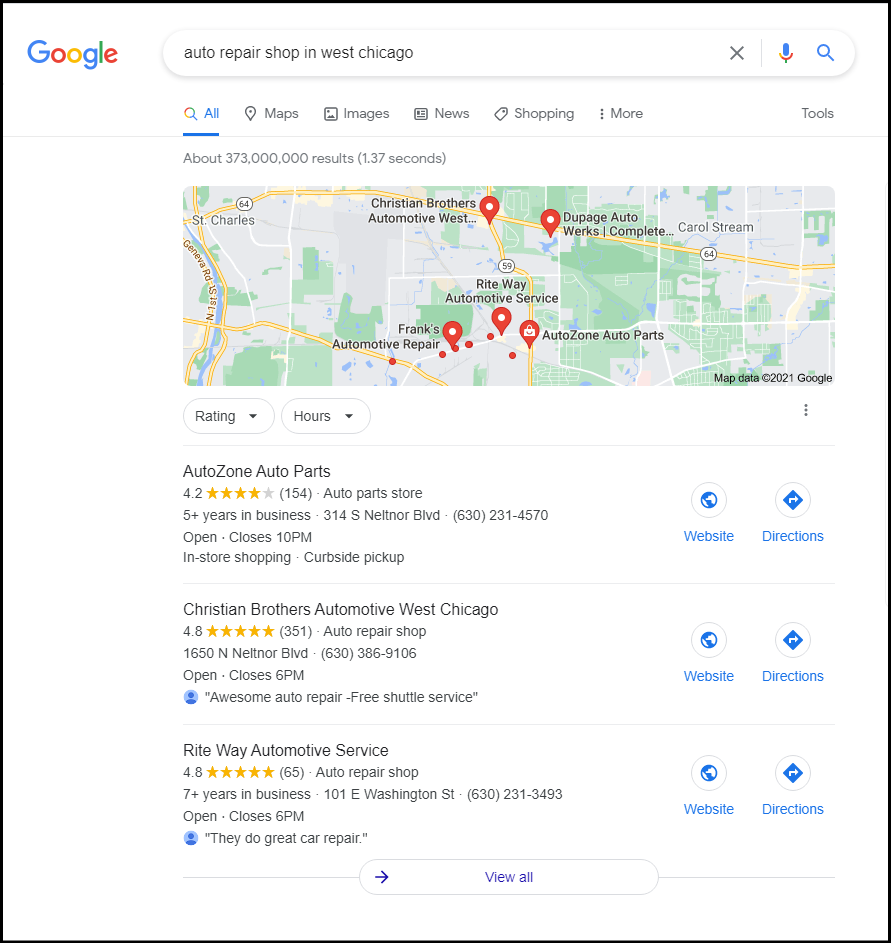
The Google Map Pack, also known as the local pack or 3-pack, displays the top three local business listings along with a map when users conduct location-based searches. For example, when someone searches "auto repair near me," the Map Pack appears at the very top of the search results, showing three local businesses with their names, ratings, locations, and contact information.
Why does this matter? Businesses in the Google Map Pack receive 40% to 50% of all local search clicks, highlighting its significant impact on visibility and traffic. If your shop isn't in that box, you're invisible to most local searchers—even if you're the best mechanic in town.
Google uses three primary factors to determine which businesses appear in the local map pack: proximity, relevance, and prominence. Understanding and optimizing for these factors is essential for any local business aiming to increase visibility and customer acquisition.
### What Will This Guide Cover?
- A clear definition of the Google Map Pack and its importance for local businesses
- The impact and benefits of appearing in the Map Pack
- The three core ranking factors: proximity, relevance, and prominence
- Step-by-step strategies to help your auto repair shop rank in the Map Pack
## The Impact and Importance of the Google Map Pack for Local Businesses
**Why the Google Map Pack Matters**
- Businesses in the Google Map Pack receive 40% to 50% of all local search clicks, highlighting its significant impact on visibility and traffic.
- The Map Pack appears above traditional organic search results, giving featured businesses a major advantage in attracting new customers.
- Google uses three primary factors to determine which businesses appear in the local map pack: proximity, relevance, and prominence.
- Claiming and optimizing your Google Business Profile (GBP) is the most important step to improve your chances of appearing in the Google Map Pack, as a complete and accurate GBP is essential for eligibility.
## Why the Google Map Pack is Your Shop's Best Marketing Opportunity
The Google Map Pack is the prominent box at the top of search results displaying a map and three business listings as the most relevant local results for searches like "auto repair near me." The Map Pack shows these three local business listings with essential details such as name, ratings, location, and contact information. It's the first thing potential customers see, and it's where your auto shop needs to be.
### What Appears in the Map Pack
- Business name
- Star rating and review count
- Address and hours
- Action buttons (website, directions, call)
### How Customers Interact with the Map Pack
When a car needs service, drivers don't scroll past the Map Pack to view other local business listings or organic results. They click one of the three shops in the Map Pack, check reviews, and either call or drive over. If your shop isn't in that box, you're invisible to most local searchers, even if you're the best mechanic in town.
### Consumer Behavior and the Map Pack
The challenge is that most shop owners are busy fixing cars, not optimizing Google Business Profiles. Improving your brand presence in local search results is crucial for visibility. Understanding what drives Map Pack rankings is crucial, whether you tackle it yourself or hire a marketing partner.
I'm Daniel Harman, and for over 15 years, I've helped local businesses dominate the Map Pack. At Auto Shop Digital, our [turn-key digital marketing services for auto repair shops](https://www.autoshopdigital.com/) are built to get independent auto repair shops the visibility they deserve. We know Map Pack placement in local business listings—especially among the three business listings featured in the Map Pack—is the difference between a full bay and an empty one.
### Quick Facts About the Google Map Pack
| What It Is | Why It Matters |
| --- | --- |
| Three highlighted business listings above organic results | Captures 44% of all clicks on search results pages |
| Includes map, reviews, hours, and contact info | 46% of Google searches have local intent |
| Driven by [Google Business Profile](/services/managed-google-business-profile) data | 50% of mobile local searchers visit a business within 24 hours |
| Appears on 93% of local searches | Businesses in the 3-Pack see 93% more customer actions |
## Why the Map Pack is a Game-Changer for Auto Repair Shops
### The Power of Local Search for Auto Repair
Picture this: a check engine light comes on in Marina Del Rey, or a driver in Covina needs an oil change. They pull out their phone and search "auto repair near me." Google responds to this local intent by displaying the Google Map Pack at the very top of Google Search, instantly showing the most relevant local businesses. Within seconds, they're looking at the Google Map Pack—that box showing three local shops with ratings, directions, and phone numbers. They will almost certainly pick one of those three.
### How the Map Pack Drives Customer Decisions
This is where your customers make their decisions. The Google Map Pack isn't just another listing; it's often the _only_ place potential customers look. Consumer behavior has shifted away from Yellow Pages and driving around. Today, 87% of mobile phone owners search for local services daily, and they need answers fast. The Map Pack provides a quick, visual snapshot of their best options.
### Consumer Behavior and the Map Pack
The visual dominance of the Map Pack is hard to overstate. It sits at the top of the page in local search results, above the blue links of traditional organic search results. On mobile devices—where nearly 80% of local searches happen—it often fills the entire screen. This prime real estate captures a whopping **44% of all clicks** on the search results page, which is why mastering [Google My Business for auto shops](/blog/seo-for-auto-shops) is so critical. If you're not in that box, you're missing out on nearly half your potential customers before they even scroll.
Visibility is just the start; the real game-changer is conversion. The Map Pack highlights the most relevant local businesses for the user's query, making it a powerful driver of action. People who find you in the Map Pack are ready to act. Businesses in the 3-Pack see **93% more actions** (calls, website visits, direction requests) than listings ranked 4-10. The numbers tell a compelling story: 88% of consumers use Google Maps to find local businesses, and approximately **50% of users making a local search on their phone visit a nearby business within 24 hours**. That's not future traffic—that's people walking through your door today.
Now that you understand why the Map Pack is so valuable, let's explore the factors that determine which businesses appear in these top spots.
## The Core Ranking Factors for the Google Map Pack
Google uses three primary factors to determine which businesses appear in the local map pack: proximity, relevance, and prominence. The local algorithm operates on these three critical pillars. Think of it as a three-legged stool—if any leg is weak, your visibility suffers. When all three are strong, you build a solid foundation to reach the top of local search and even position your shop for [Generative Engine Optimization and AI-driven visibility](/blog/automotive-website-optimization).
### Relevance: Matching Your Shop to the Search Query
Relevance answers a simple question: does your business offer what the searcher wants? If someone searches "brake repair Covina," Google aims to show them shops that do brake work in Covina.
- **Google Business Profile (GBP) Categories:** This is a crucial relevance signal. Your primary category might be "Auto Repair Shop," with secondary categories like "Brake Shop" or "Oil Change Service." Choose them carefully to tell Google what you do.
- **Business Description & Services:** Clearly explain your services. Mention specifics like engine diagnostics, transmission repair, or smog checks. Use the services section in your GBP to list everything you offer, helping Google match you to more queries.
- **Website Content:** Your website supports your relevance. Dedicated pages for major services (e.g., "Brake Repair in Marina Del Rey") send strong signals to Google, connecting your [online presence](/services/managed-local-seo) to real customer searches as part of a complete [auto repair digital marketing strategy](/blog/auto-repair-digital-marketing-ultimate-guide).
### Proximity: How Close Are You to the Searcher?
Proximity is straightforward: Google wants to show users businesses that are convenient to visit. It detects a searcher's location via GPS or IP address and prioritizes nearby businesses.
A customer in Marina Del Rey will see different Google Map Pack results than someone in Covina, even for the same search term. The rise of **"near me" searches** explicitly tells Google that distance is a key factor. Even searches like "auto repair Covina CA" have local intent, making proximity important within that geographic area.
You can't change your shop's location, but you can ensure Google knows exactly where you are. This makes the other two pillars—relevance and prominence—even more critical for outranking nearby competitors.
### Prominence: Your Shop's Authority and Reputation
Prominence is Google's measure of how well-known and trusted your business is. It's your shop's credibility score.
- **Online Reviews:** The quantity, quality, and recency of your reviews are a massive prominence signal. A shop with 150 five-star reviews appears more trustworthy than one with only a few. Review velocity—a steady stream of new reviews—is also important, as it shows your business is active.
- **Backlinks:** Links to your website from other reputable sites (like a local news outlet or the Chamber of Commerce) act as votes of confidence, boosting your authority.
- **Local Citations:** These are mentions of your business Name, Address, and Phone number (NAP) across the web in directories and social media. Consistency is key; different information in different places creates confusion and weakens your prominence.
- **Website Authority:** A well-built, mobile-friendly website with quality content indirectly boosts your Map Pack prominence by showing Google you're a legitimate, professional business.
## Your Step-by-Step Guide to Ranking in the Map Pack
Getting your auto shop into the Google Map Pack is a methodical process. It requires attention to detail and consistency, much like tuning up a car. These actionable steps will help you build a long-term local SEO strategy that keeps your shop visible to searching customers.
### 1. Claim and Boost Your Google Business Profile
Your Google Business Profile (GBP) is the engine driving your Google Map Pack visibility. Without a complete and optimized profile, you're invisible to local searchers.
- **Claim and Verify:** Go to Google Business Profile to find and claim your listing. If it doesn't exist, create one. Google will verify your business, usually by mailing a postcard with a code to your shop's address.
- **Complete Everything:** Once verified, access your Google Business Profile dashboard and fill out every single section. Use your accurate business name, address, phone number, website, and hours. Add attributes like WiFi or wheelchair accessibility.
- **Select Categories:** Your primary category should be "Auto Repair Shop." Add secondary categories for your specialties, like "Brake Shop" or "Tire Shop," to improve relevance.
- **List Services and Products:** Detail all your services, from oil changes to engine diagnostics. This helps Google match you to specific searches.
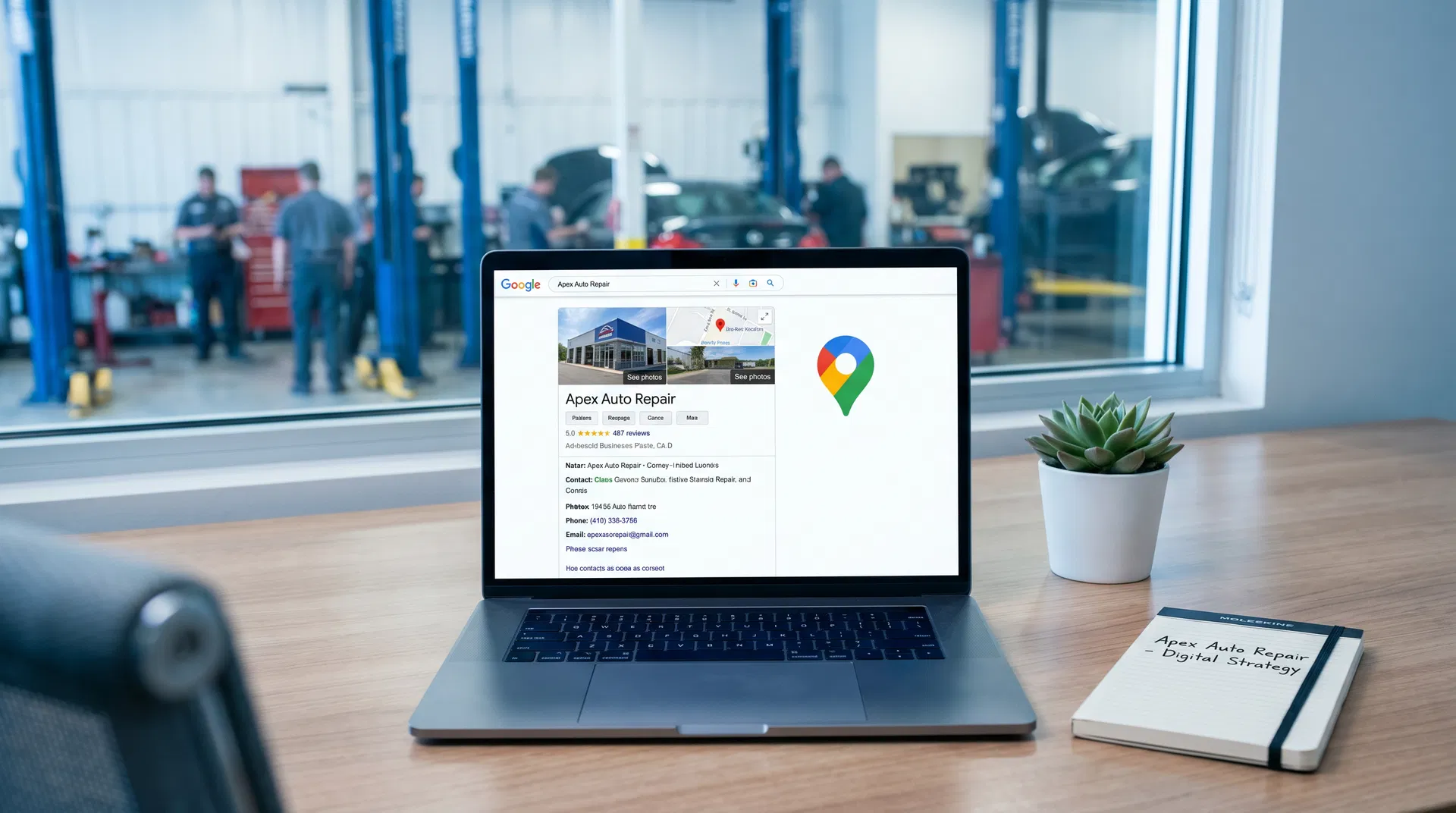
- **Upload Photos:** Add high-quality images of your shop's exterior, waiting area, and team. Listings with photos get far more engagement.
- **Use Google Posts:** Share updates, specials, or tips via Google Posts, and make sure your Google Business Profile is regularly updated with fresh information and posts. Consistently updating your profile and engaging with your audience signals to Google that your business is active, reliable, and worthy of higher visibility.
### 2. Master Your Online Reputation with Reviews
Online reviews are a critical ranking factor and a powerful conversion tool. In fact, 94% of consumers say positive reviews make them more likely to use a business.
- **Ask for Reviews:** The easiest way to get reviews is to ask. Train your staff to request one when a customer is happy with their service. Use a follow-up text or email containing a direct link to your Google review page to simplify the process for customers.
- **Respond to All Reviews:** Thank customers for positive reviews to show you value their feedback. For negative reviews, respond professionally and promptly. Acknowledge their concern, apologize, and offer to resolve the issue offline. A response like, "We're sorry we didn't meet your expectations. Please call us directly so we can make this right," shows potential customers you care about quality service.
Consistent review management—monitoring, responding, and earning new reviews—builds social proof and boosts your search rankings.
### 3. Build Trust with Local Citations and NAP Consistency
Local citations are online mentions of your business's Name, Address, and Phone number (NAP). They act as votes of confidence that tell Google your shop is a legitimate local business.
The golden rule is consistency. Your NAP information must be exactly the same everywhere it appears. Even minor differences like "Street" vs. "St." can confuse Google and hurt your rankings.
Start by ensuring your website and GBP are perfect. Expand to major directories like Yelp and Facebook, as well as automotive-specific sites and local directories. Getting listed in local directories is crucial for citation building, as it helps verify your business information and boosts your local search visibility.
This process, known as citation building, is a key part of the [Top 10 Benefits of SEO for Auto Body Shops](/blog/auto-body-shop-seo) and is central to effective [7 Local Auto Repair Marketing Ideas to Try in Your Area](/blog/local-auto-repair-marketing-ideas).
### 4. Align Your Website with On-Page Local SEO
Your website and GBP work together to signal relevance and authority. A well-optimized site helps you rank in the Google Map Pack and convert clicks into customers.
- **Use Location-Specific Keywords:** Target terms like "brake repair Marina Del Rey CA" to match what local customers are searching for.
- **Create Service & Location Pages:** Build dedicated pages for each major service (e.g., Transmission Repair) and consider creating pages for each city you serve. Publishing locally relevant content on these pages further boosts your site's authority and improves local search visibility.
- **Implement Local Schema:** Add local business schema markup to your site. This structured data gives Google a cheat sheet about your business details, making it easier to understand and rank.
- **Be Mobile-Friendly and Fast:** With most local searches happening on mobile, your site must have a responsive design and load quickly. Google's mobile-first indexing prioritizes sites that work well on phones.
A modern website is a vital marketing asset. Learn more about [Why Your Auto Shop Needs a Modern Professional Website](/blog/why-your-auto-shop-needs-a-modern-professional-website) and how it influences the Online Consumers Thought Process. Modern shops can also increase efficiency and customer satisfaction by leveraging [automotive shop management software solutions like Tekmetric, Mitchell 1, and Identifix](/blog/automotive-shop-management-software) alongside [workshop management platforms such as Workshop Software, Garageplug, and MechanicDesk](/blog/workshop-management-software). For a complete walkthrough of every Google channel available to auto shops—from your Business Profile to Google Ads—see our guide to [growing your business on Google](/blog/business-on-google).
For shops looking to go beyond the basics, [high-quality exclusive lead generation for auto repair and mobile mechanics](/blog/mobile-mechanic-leads) and a well-rounded [automotive advertising agency's integrated marketing strategy](/blog/automotive-advertising-agency) can accelerate your results significantly. You may also want to explore [video marketing strategies for automotive businesses](/blog/car-dealership-video-marketing) as a way to stand out in the Map Pack with rich visual content.
## Frequently Asked Questions
Unlock Local Visibility: Demystifying the Google Map Pack
By Daniel Harman•December 23, 2025
Ready to Grow Your Auto Shop?
Turn Readers Into Customers
Our turn-key marketing services are built exclusively for auto repair shops. Pick the service that fits your goals and get started today.
Managed Local SEO
Rank higher on Google and Google Maps for 'auto repair near me' searches.
Google Business Profile
Dominate the Local Pack with a fully optimised Google Business Profile.
Google Ads
Get immediate leads with targeted PPC campaigns for auto repair keywords.
Website Design
A fast, SEO-optimised website built to convert visitors into booked jobs.
Related Articles

SEO
Business on Google: How Auto Shops and Auto-Related Businesses Can Set Up, Optimise and Grow Their Presence
Boost your business visibility on Google with practical strategies for growth. Discover actionable tips to enhance your online presence.
Read more
SEO
Your Pit Crew for Rankings: How to Choose Auto Repair SEO Experts
Find top auto repair SEO experts to boost your shop's online visibility, attract local customers, and drive more appointments. Get results!
Read more
SEO
Beyond the Showroom: How Automotive SEO Services Fuel Your Digital Presence
Drive your auto shop to the top! Learn how Automotive SEO Services boost online visibility, attract customers & grow your business.
Read more