TL;DR
This guide covers everything auto shop owners in Marina del Rey need to know about digital marketing and website optimization. You'll learn about the shift from traditional SEO to Generative Engine Optimization (GEO), how to build content around E.E.A.T. principles, technical SEO fundamentals, conversion rate optimization, and how to measure success. The bottom line: optimizing your digital presence increases visibility, attracts high-value customers, and drives measurable growth for your business.
Mastering Automotive Website Optimization: Your Auto Shop Digital Marina Del Rey Showroom
This guide is designed for auto shop owners and managers in Marina del Rey who want to master digital marketing and website optimization. You'll learn why these strategies matter, what tools and tactics are most effective, and how to stand out in a competitive local market. Mastering digital strategies is crucial for local business growth, as more customers rely on online searches to find trusted auto repair services. By optimizing your digital presence, you can increase your shop's visibility, attract more high-value customers, and drive measurable growth for your business.
Auto shop digital marketing services in Marina del Rey help auto repair shops attract more customers for their cars by enhancing their online visibility and connecting them with local drivers in need of automotive services. In today's digital-first world, having a strong online presence is no longer optional—it's essential for staying competitive and growing your business.
The AI Revolution: Shifting from SEO to Generative Engine Optimization (GEO)
A fundamental shift is happening in how customers find auto shops. For years, Search Engine Optimization (SEO) was about ranking your link at the top of Google for keywords like "brake repair near me."
Now, AI-powered search engines like ChatGPT, Gemini, and Google's AI Overviews don't just show links—they answer questions directly. When someone asks, "Where's the best place for an oil change in Santa Monica?" AI synthesizes information to provide a complete answer, no clicking required.
This shift is the heart of Generative Engine Optimization (GEO). Instead of just ranking high, you're optimizing to become the trusted source AI uses to answer customer questions. It's about being the answer, not just a link to it.
Your customers use conversational language with AI, asking questions like, "What should I do if my check engine light comes on?" GEO optimizes for these natural, real-world queries. This is also related to Answer Engine Optimization (AEO), which focuses on pulling direct answers for features like Featured Snippets. Both aim to make your expertise visible when customers need it.
Approximately 46% of all Google searches are seeking local information, highlighting the importance of local SEO for businesses targeting specific geographic areas.
How the Landscape Has Shifted
| Feature | Traditional SEO | Generative Engine Optimization (GEO) |
|---|---|---|
| Primary Goal | Rank high on SERPs, get clicks to your website | Be the trusted source for AI-generated answers, get cited by AI tools |
| Keywords | Short, broad keywords; exact match | Conversational, long-tail questions; natural language queries |
| Content Focus | Keyword-rich articles, backlinks | Answer-first structure, comprehensive answers, demonstrating E.E.A.T. (Experience, Expertise, Authoritativeness, Trustworthiness) |
| AI Interaction | Indirect (AI uses data for general understanding) | Direct (AI synthesizes and presents your content as an answer) |
| Measurement | Rankings, organic traffic, bounce rate | AI visibility (being cited), presence in AI Overviews, direct answer engagement |
GEO doesn't replace traditional SEO; it builds on it. You still need a fast, mobile-optimized site with quality content and solid technical health. The shops that win will combine strong SEO with smart GEO strategies. Specialized marketing services for auto repair shops are essential for staying competitive in the digital landscape, and our turn-key digital marketing services for auto shops [blocked] are built specifically to help shops grow. Learn more about building this foundation with our Auto Repair SEO Service [blocked].
What is Generative Engine Optimization (GEO)?
Generative Engine Optimization is about making your content so clear, structured, and trustworthy that AI tools can easily understand and use it to answer questions. If your website has detailed service info, client success stories, customer testimonials, and transparent pricing, AI is more likely to cite your shop when a user in Long Beach asks for a recommendation.
Our clients have benefited from these strategies by attracting and retaining high-value customers, improving their reputation, and achieving measurable growth in revenue and online presence. Businesses with a higher number of positive online reviews tend to attract more customers, as 84% of people trust online reviews as much as a personal recommendation.
The old model was a library card catalog; the new model is a knowledgeable librarian who gives you the answer directly. AI tools are that librarian, and you need to provide them with the best information.
Why Adopting GEO is Crucial for Your Auto Business
If your shop isn't optimized for AI search, you're becoming invisible to a growing number of customers asking AI for recommendations like, "Which dealership has the best service department near Beverly Hills?" If your content isn't clear and authoritative, you won't be part of the conversation.
Businesses that optimize for local SEO can see a 28% increase in local search visibility, which directly correlates to higher customer engagement and sales. Our guide to Google My Business for auto shops [blocked] walks through how to turn that visibility into real-world revenue.
This isn't a trend; it's the future. Automotive website optimization now means preparing for a future where AI mediates customer research. Customers using conversational AI search are often high-intent buyers looking for immediate solutions. By answering their questions directly, you become the shop they call. While your competitors are still figuring out GEO, you can establish your shop as the authoritative voice in your area. GEO strategies have led to measurable growth for auto repair shops, including improvements in revenue, online traffic, lead generation, and local search rankings.
In short, GEO helps real people get real answers faster. When your content is written for human questions and structured for machines, you show up where decisions are made: inside AI-generated answers.
Local SEO and Digital Marketing for Auto Shops in Marina del Rey
Local SEO is crucial for auto shops in Marina del Rey to appear in local search results, which can significantly increase foot traffic and customer inquiries. Optimizing your Google Business Profile can enhance your visibility in local search results, making it easier for potential customers to find your auto shop online. Businesses that optimize for local SEO can see a 28% increase in local search visibility, which directly correlates to higher customer engagement and sales.
To maximize your local presence, focus on:
- Claiming and optimizing your Google Business Profile with accurate information, photos, and customer reviews.
- Using location-specific keywords such as "auto shop digital Marina del Rey" throughout your website and content.
- Encouraging satisfied customers to leave positive reviews, which serve as trust signals for both Google and potential clients.
- Ensuring your shop's name, address, and phone number (NAP) are consistent across all online directories.
Approximately 46% of all Google searches are seeking local information, highlighting the importance of local SEO for businesses targeting specific geographic areas. By prioritizing local SEO and digital marketing strategies, auto shops in Marina del Rey can stand out in a crowded market and attract more customers from their community.
Building a High-Performance Website: Content and E.E.A.T.
In the age of AI, your website's content needs a new approach. It's not enough to describe what you do; you must answer the questions your customers are asking. Automotive website optimization now hinges on this principle.
Answer-First Content Strategy
Customers today ask their phones, "How often should I get my brakes checked?" instead of just typing "brake service." We use an answer-first approach, putting the most important information at the top. These strategies are designed to drive traffic to auto repair shop websites by increasing visibility and engagement.
A page titled "How Often Should I Get My Brakes Checked in Long Beach?" that immediately gives the answer (e.g., every 10,000 miles) is more effective than a generic service page. These longer, natural phrases, or conversational long-tail keywords, capture high-intent customers, and the same approach powers body shop marketing strategies that boost car counts [blocked].
Effective SEO strategies for auto shops include:
- Comprehensive keyword research to identify relevant, high-volume, and low-competition keywords that can drive targeted traffic to their websites.
- Creating content that directly answers common customer questions.
- Structuring pages for easy scanning and quick answers.
Leveraging Customer Reviews
79% of consumers trust online reviews as much as personal recommendations. Reviews are a major trust signal for Google and AI engines. Your five-star reviews from customers in Beverly Hills and Marina del Rey are essential content. This trust extends to your visual presence, from your logo to your website design. Learn more in our guide on Why Visual Branding Is Critical to an Auto Shop's Success [blocked].
How to Build E.E.A.T. for AI Search Engines
E.E.A.T. stands for Experience, Expertise, Authoritativeness, and Trustworthiness. Google and AI search engines use these factors to evaluate and rank your website. For auto shops, it's about proving you're the real deal.
- Experience: Show, don't just tell. Share case studies of complex repairs, before-and-after photos, and the history of your shop. Maintaining detailed digital records also helps clients track maintenance history and plan for future car needs.
- Expertise: Demonstrate deep knowledge. Write detailed service descriptions, create blog posts answering common questions, and display technician certifications. Dealerships can also partner with specialized automotive advertising agencies [blocked] to amplify that expertise across every marketing channel.
- Authoritativeness: Become the go-to source. Earn backlinks from reputable local sites, get featured in local news, and build a strong Google Business Profile [blocked].
- Trustworthiness: Build confidence with every click. Feature customer testimonials, offer transparent pricing, and make your contact information easy to find. Video testimonials are especially powerful; see how to use them in our guide on How Video Marketing Strategies Can Benefit Auto Shops [blocked], and explore car dealership video marketing strategies [blocked] if you also run a sales operation alongside your service department.
By focusing on E.E.A.T., you create content that not only ranks well but also helps auto repair shops attract and retain loyal customers, supporting long-term business growth.
Technical SEO: The Engine Under the Hood
If content is the fuel, technical SEO is the engine. It involves the behind-the-scenes efforts that ensure search engines can discover, crawl, and interpret your website effectively. Without a solid technical foundation, even the best content will stall.
Key Components of Technical SEO
- Site Speed: Your site must load quickly, especially on mobile. A one-second delay can reduce conversions by 7%.
- Mobile-First Design: With over 60% of searches happening on mobile, your site must be flawless on a smartphone.
Clean URL Structure
Logical, simple URLs (e.g., yourshop.com/brake-repair) are easier for both users and search engines to understand.
Schema Markup
This is code that tells search engines what your content is about. For an auto shop, you can use Schema to define your services, hours, and location. Proper schema implementation can also improve your ranking and visibility in Google Maps results. Learn more from this Technical SEO explained by Yoast article or visit Schema.org.
Expertise and Google Map Pack Visibility
Employing ASE-certified technicians can enhance your shop's service capabilities, especially for complex electrical and hybrid systems.
Pairing that with strong Google Map Pack visibility for auto repair shops [blocked] makes it easier for nearby drivers to find and trust you.
Think of it like this: a clean, well-organized shop is easier for customers to navigate. The same is true for your website. A strong technical SEO setup makes it easy for search engines to see what you offer and recommend you to customers.
Mobile Optimization Best Practices
- Ensure your website is responsive and adapts to all screen sizes.
- Optimize images and compress files for faster loading.
- Use large, easy-to-tap buttons for calls to action.
- Test your site regularly on different devices to ensure a seamless user experience.
Conversion Rate Optimization (CRO): Turning Visitors into Customers
Getting visitors to your site is only half the battle. Conversion Rate Optimization (CRO) is the art and science of turning those visitors into paying customers. It's about making it as easy as possible for a prospect to take the next step, whether that's calling your shop, booking an appointment, or getting directions. Investing in website optimization is an investment in your shop's future success, helping you stand out in the competitive auto shop digital Marina del Rey market.
A well-designed website should have clear calls to action, easy-to-find contact information, and lead capture forms that don't ask for too much information upfront. Digital services at auto shops facilitate faster communication and real-time status updates, reducing downtime and eliminating paperwork, especially when you use modern automotive shop management software [blocked] to centralize your operations.
Essential CRO Strategies for Auto Shops
- Clear Calls-to-Action (CTAs): Buttons like "Schedule Service Now" or "Call for a Quote" should be prominent and easy to find. For more on this, check out our guide on 7 Tips You Need for Designing a New Auto Shop Website [blocked].
- Simple Navigation: Customers should be able to find what they need in just a few clicks. Don't make them hunt for your phone number or service list.
- Trust Signals: Display customer reviews, certifications (like ASE), and photos of your team and shop. This builds confidence and reduces friction.
- Lead Capture Forms: Make your forms short and simple. Only ask for the information you absolutely need to book an appointment. For mobile mechanics especially, dedicated exclusive mobile mechanic lead services [blocked] can keep your pipeline full while your site converts those visitors efficiently.
According to research on the Online Consumers Thought Process, a streamlined experience is critical. Every extra click or confusing step is a chance to lose a customer. By optimizing for conversions, you're not just getting more leads—you're creating a better customer experience from the very first click.
Measuring Success: The Tools of the Trade
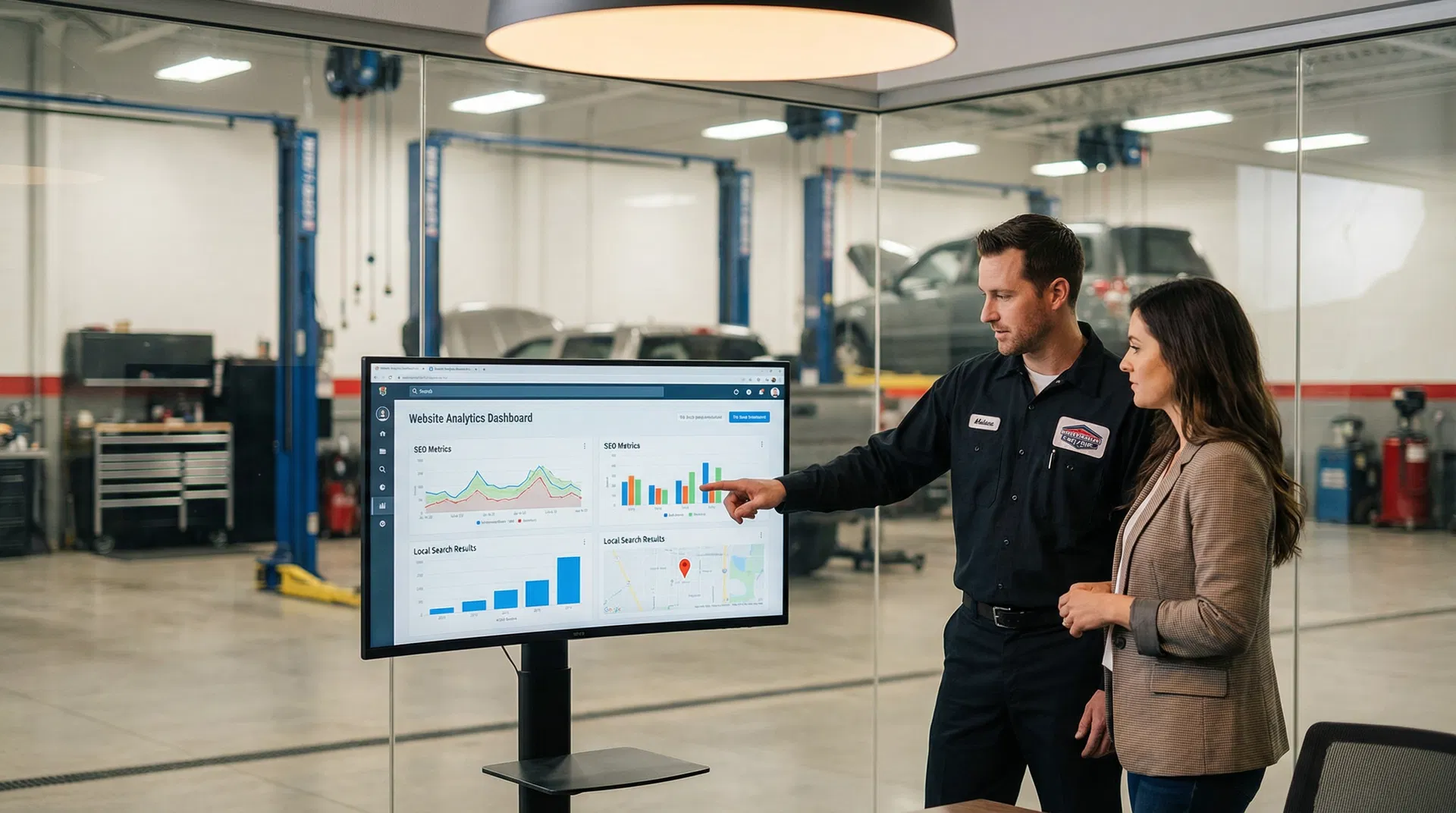
Optimization is an ongoing process, not a one-time fix. To know what's working, you need to track your performance—including key metrics like revenue growth, which is essential for auto repair shops looking to measure the impact of digital marketing efforts. Tools like Google Analytics and Google Search Console are your dashboard for measuring success.
A well-managed Google Business Profile can lead to increased customer engagement, including more phone calls and website visits, which are crucial for local businesses like auto shops.
Our flexible, month-to-month service agreements mean you have no long-term commitment, so you can see results and progress without pressure.
Ready to grow your shop? Join Auto Shop Digital Marina del Rey today and experience the benefits of expert SEO, increased revenue, and a supportive community dedicated to your success.
Key Metrics to Track
- Organic Traffic: How many visitors are finding you through search engines?
- Keyword Rankings: Where do you appear for important terms like "transmission repair in Santa Monica"?
- Conversion Rate: What percentage of visitors are booking appointments or calling your shop?
- Bounce Rate: How many visitors leave your site after viewing only one page?
Shop owners can use these metrics to track their business performance. Regularly updating your Google Business Profile with accurate information, photos, and customer reviews can improve your ranking in Google Maps and attract more customers to your auto shop.
By monitoring these metrics, you can identify what's working and where you need to improve. This data-driven approach is at the core of a successful automotive website optimization strategy. It allows you to make informed decisions and continuously refine your approach for better results.
Ready to put these strategies into action? Explore our Managed SEO service [blocked] to see how we can help you build a high-performance website that drives real-world results. Or, if you're ready to start a project, Get Started [blocked] with a free consultation today.