TL;DR
Independent collision repair shops face more competition than ever. Dealer collision centers have expanded, national chains have consolidated, and customers now compare multiple shops online before making a decision. Most auto body shops still haven't invested in real marketing—which creates a significant opportunity for those willing to take action. This guide covers practical auto body shop marketing strategies you can implement immediately, plus longer-term approaches that build predictable car count and higher-quality jobs.
Quick-Start Guide: Get More Cars in the Door This Month
Before diving into comprehensive strategy, here are fast wins you can execute this week. These low-effort actions can start generating calls within days, not months.
Same-Week Checklist
- Claim and fully optimize your Google Business Profile with correct categories (Auto Body Shop, Auto Dent Removal Service), complete business hours, and detailed services (frame straightening, paintless dent repair, ADAS calibration)
- Ensure your business listing is consistent across all platforms, including your website, Google, and social media accounts, to maximize local reach and credibility
- Add 10+ high-quality photos of recent 2024–2026 repairs, including before-and-after photos of collision damage, hail repairs, and bumper work
- Enable messaging and click-to-call functionality on your Google Business page
- Ask 5 satisfied customers from recent jobs for Google reviews—provide them a direct link via text or email at vehicle pickup
- Turn on the Q&A feature and answer common questions proactively
Quick Promotional Wins
- Create a limited-time "Spring 2026 Collision Check" or "Hail Damage Estimate Week" offer
- Post this promotion via Google Business Posts (visible for 7 days in your listing)
- Share the same offer on Facebook with geo-targeting to your service area
- Add simple online booking through Calendly or a basic estimate form to capture after-hours leads
Real Example: A 6-bay shop in Phoenix added 18 new reviews in 30 days and saw a 22% increase in estimate requests. Review velocity and recency directly correlate with inquiry rates—this isn't theory, it's measurable.
Why Auto Body Shops Need a Real Marketing Plan in 2026
The landscape has shifted dramatically since 2020. Dealer collision centers and national chains have expanded aggressively, while many independent shops still operate the same way they did a decade ago.
Key reasons marketing matters now:
- Most shops still average under 15 jobs per week and rely heavily on DRPs and word of mouth for new business
- Consumer behavior has fundamentally changed—customers now compare at least 2–3 shops online before choosing where to repair their car
- Approximately 46% of Google searches are local, and the majority of local searchers contact a business within 24 hours
- Many independent body shops still lack a modern website, consistent branding, or review strategy—this creates opportunity for shops willing to invest
- Insurance companies are tightening DRP network agreements, reducing margins and control for participating shops
Marketing for an auto body shop isn't about gimmicks or viral content. It's about predictable car count, better-quality jobs, and reducing dependence on sources you don't control.
Targeting Local Drivers Within Your Service Radius
Body shop marketing is hyperlocal by definition. Most of your customers live within 5–15 miles of your location, constrained by rental car policies, convenience, and insurance referral networks.
Local SEO fundamentals:
- Include geographically specific keywords in website copy and meta titles: "auto body shop [city]," "collision repair [city]," and nearby suburbs
- Ensure accurate NAP (name, address, phone) consistency across Google Maps, Apple Maps, Bing Places, Yelp, and top local directories
- Discrepancies in business name format, address spelling, or phone number fragment your local search authority
- Embed a Google Maps location on your contact page—this signals legitimacy to search engines and provides customers easy directions
Mini-Example: A shop near I-95 in New Jersey could use geo-targeted ads to reach commuters within a 10-mile corridor. Location-based paid advertising through Google Ads and Facebook supports granular controls—zip code, radius around address, or specific street boundaries.
Optimizing Your Google Business Profile for Collision Searches
Your Google Business Profile is often the first impression for "auto body shop near me" and "collision repair" searches. When local customers search, the GBP listing appears prominently in local pack results and maps.
Essential optimization elements:
- Primary category: Auto Body Shop; secondary categories: Auto Dent Removal Service
- Detailed services listed: frame straightening, paintless dent repair, ADAS calibration, glass repair, paint correction, bumper repair, hail damage repair
- Accurate business hours, especially noting weekend or after-hours availability
- Real repair photos from 2024–2026 jobs showing genuine collision damage, hail damage, and cosmetic repairs
Active engagement features:
- Use Google Posts to highlight seasonal offers, insurance claim assistance, and financing options
- Enable messaging so customers can ask questions directly without calling
- Proactively manage the Q&A section with answers to common questions: turnaround times, insurance process, warranty coverage
- Respond to all Q&A within 24–48 hours to signal professionalism
For shops that want professional management of their Google Business Profile, Auto Shop Digital's managed GBP service [blocked] handles optimization, posting, and review management on your behalf.
Building a Website That Converts Browsers into Booked Estimates
The goal isn't a pretty site—it's a website that generates estimate requests and phone calls. Your site should prioritize clarity, fast load times, and clear calls-to-action over design awards.
Must-have pages:
- Home: Clear value proposition, hero image of recent quality repair, prominent "Request Estimate" or "Call Now" CTA above the fold
- Services: Separate pages for collision repair and cosmetic repair, each explaining capabilities, typical turnaround, and warranty
- Insurance & DRP Info: Explanation of how claims work and that customers have the legal right to choose their repair shop
- Before & After Gallery: Dated repair photos with vehicle make/model, damage type, and turnaround time
- About/Team: Photos and brief bios of key staff to build trust
- Contact/Estimate: Multiple contact options including a mobile-optimized estimate form requesting damage photos
Mobile-first design is critical: Most accident-related searches happen on phones—roadside after a collision or at home reviewing options. Your site needs large tap-to-call buttons, simplified navigation, and fast-loading images.
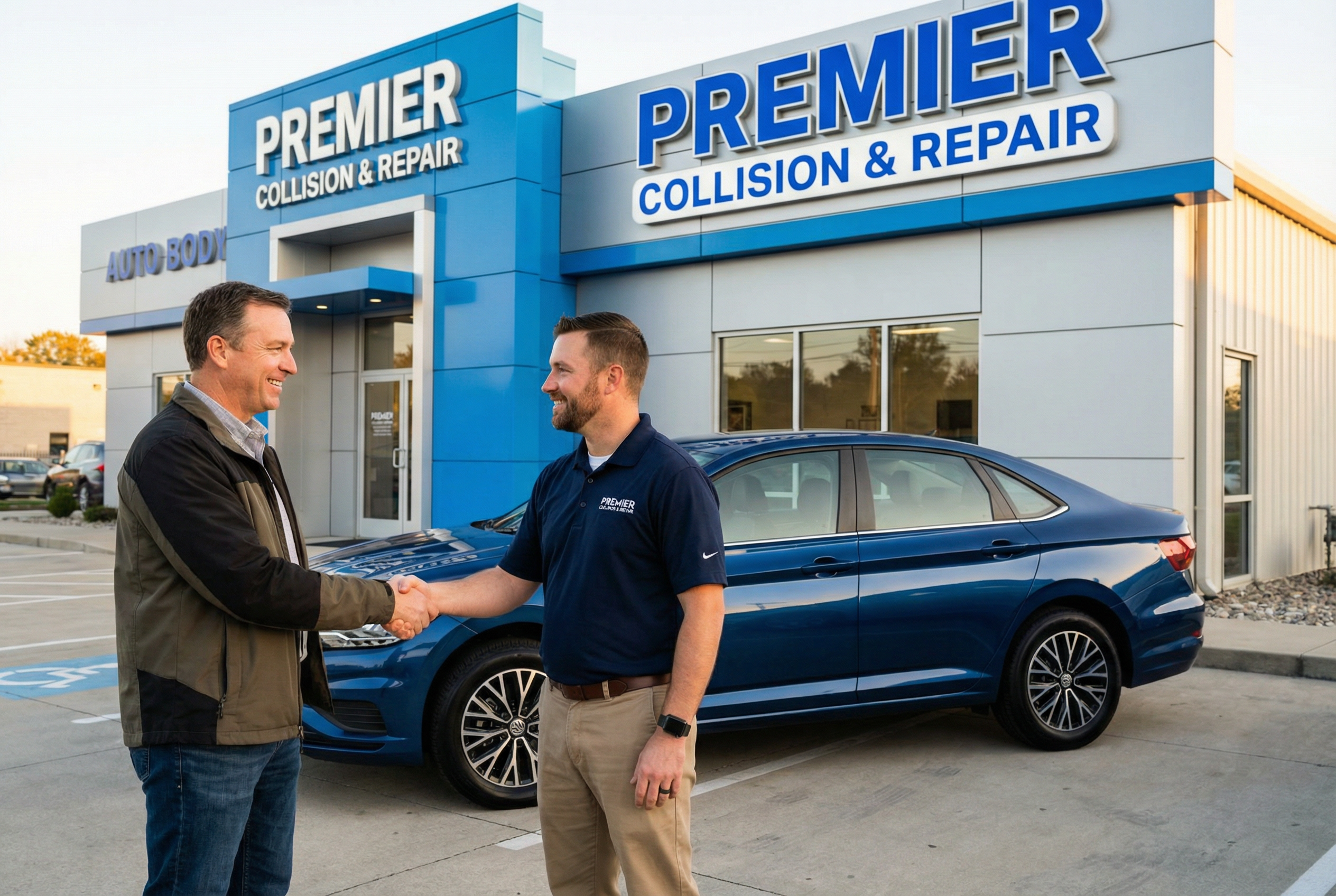
Review Generation: The Most Underutilized Growth Lever
Reviews are the single highest-ROI marketing activity for most body shops. A shop with 200+ reviews at 4.7+ stars outranks competitors in local pack results and converts at significantly higher rates.
Systematic review generation:
- Ask at vehicle pickup—verbally and with a text link to your Google review page
- Send a follow-up text 24–48 hours after pickup: "We hope your [make/model] is running great. If you're happy with the repair, a quick Google review helps our small business enormously."
- Train every service advisor to make the ask part of their standard closing process
- Never offer incentives for reviews—this violates Google's policies
Responding to reviews:
- Respond to every review, positive and negative, within 24 hours
- For negative reviews, acknowledge the concern, offer to resolve it offline, and provide a direct contact method
- Responses demonstrate professionalism to future customers reading the reviews
Digital Marketing Channels That Drive Quality Leads
You don't need every channel. Select 2–4 that match your target market, budget, and internal capacity.
Paid Search (Google Ads): Targeting keywords like "auto body shop near me," "collision center [city]," and "insurance collision repair" captures high-intent leads actively searching. Even modest budgets ($500–$1,000/month) can generate measurable results when properly targeted.
Facebook and Instagram Ads: Run local campaigns geo-targeted within 10–15 miles for hail events, winter collision season, or cosmetic repair specials. Social media advertising excels at reaching people who aren't actively searching but become interested when they see compelling before-and-after content.
Retargeting: Retargeting ads follow visitors who looked at estimate pages but didn't contact the shop. These warm leads often need multiple touchpoints before converting.
Email Marketing: Simple email campaigns serve two functions—service updates during active repairs, plus maintenance reminders and special promotions to previous collision customers.
Gallery and Visual Content Strategy
Collision repair is inherently visual. Before-and-after photos are your most powerful marketing asset—they demonstrate competence in a way no text can replicate.
Gallery best practices:
- Create a dedicated gallery page featuring dated before-and-after sets from 2023–2026 repairs
- Include brief captions: vehicle make/model, type of damage, turnaround time (e.g., "2022 Honda Civic – rear-end collision, 8 business days")
- Use these visuals across multiple channels: social media, Google Business photos, and occasional local print ads
- Create at least one "case study" style story per quarter featuring complex repairs or restorations
Case study example format: "This 2024 Tesla was hit by a texting driver—structural damage to the frame, crushed passenger door, and electronic system failures. Our technicians spent 40 hours rebuilding the frame, replacing the door with OEM parts, and recalibrating the ADAS system. Delivered 12 days later with full function and warranty."
Using Direct Repair Programs and Alternatives Wisely
DRPs can provide steady volume, but they come with constraints that affect margins and flexibility.
| DRP Pros | DRP Cons |
|---|---|
| Steady volume without customer acquisition cost | Pricing constraints (often 10–20% below retail) |
| Reliable baseline revenue | Parts sourcing restrictions |
| Insurance referral flow | Reduced shop autonomy |
Recommended balance:
- Target a healthy mix: ~50% DRP work (stable), 30% direct retail (highest margin), 20% non-DRP insurance
- Invest in marketing efforts to capture retail and non-DRP insurance customers
- Explain clearly on your website and in print that customers have the legal right to choose their auto body repair shop
Customer Retention and Loyalty Programs
Acquiring new customers is just the starting point—transforming them into lifelong advocates is where the real profit margins emerge. Industry data shows that repeat customers generate 67% higher lifetime value, consistently approve higher-ticket repair recommendations, and deliver the 5-star Google reviews that separate top-performing shops from the competition.
Retention tactics that work:
- Send a 30-day follow-up message checking on vehicle satisfaction
- Offer a complimentary detail or wash with the next service visit
- Build a referral program: "Refer a friend and receive $50 off your next repair"
- Send annual reminders for seasonal checks (hail season, winter prep)
Measuring Results and Improving Your Marketing Over Time
Even small business owners should track a few core numbers monthly to avoid wasting ad spend.
Key metrics for a 4–8 bay shop:
| Metric | What It Tells You |
|---|---|
| Number of leads (calls, forms, walk-ins) | Marketing reach |
| Booked estimates | Lead quality |
| Closed repair orders | Conversion effectiveness |
| Average repair order (ARO) | Job value |
| Cost per lead by source | Channel efficiency |
Attribution methods:
- Ask every new customer "How did you hear about us?" and record the answer
- Use unique phone numbers for different marketing channels (Google Ads gets one number, Facebook another)
- Track website traffic sources through Google Analytics
Monthly review routine: Schedule the first Monday of each month to review website traffic, ad performance, and review growth. This 30-minute commitment prevents drift and ensures quick course correction.
Scaling strategy: Start with 2–3 core marketing strategies, master them over 3–6 months, then layer on more channels as capacity and revenue grows. The shops winning in 2026 are those taking systematic control of their marketing—not chasing every tactic, but executing the fundamentals consistently.
Begin this week: optimize your Google Business Profile, request reviews from happy customers, and track where your new business actually comes from. Build from there. For shops looking for professional marketing support, explore our auto body shop marketing services [blocked] and managed local SEO plans [blocked].
Frequently Asked Questions
How much should an auto body shop spend on marketing?
Most independent shops should allocate 3–5% of gross revenue to marketing. For a shop doing $1M annually, that's $30,000–$50,000/year, or $2,500–$4,200/month. Start with the highest-ROI activities (Google Business Profile optimization, review generation, local SEO) before adding paid advertising.
What's the fastest way to get more collision repair jobs?
The fastest path is optimizing your Google Business Profile and aggressively generating reviews. A shop with 100+ recent reviews at 4.5+ stars will outrank competitors in local pack results within 30–60 days of consistent effort.
Should auto body shops use social media?
Yes, but selectively. Facebook and Instagram are the most effective platforms for most body shops. Focus on before-and-after content, staff introductions, and seasonal promotions. Post 2–3 times per week consistently rather than sporadically.
How important is SEO for auto body shops?
Very important. Most collision repair customers search online before choosing a shop. Ranking on page 1 for "auto body shop [city]" and "collision repair [city]" can generate 10–30 new leads per month without ongoing ad spend.
What should an auto body shop website include?
At minimum: a clear homepage with a "Request Estimate" CTA, a services page, a before-and-after gallery, an insurance/DRP information page, and a contact page with a mobile-optimized estimate form. Every page should have a visible phone number and click-to-call functionality.
Ready to put these strategies into action? Auto Shop Digital [blocked] offers fully managed local SEO [blocked], Google Business Profile management [blocked], Google Ads management [blocked], and automotive website design [blocked] built specifically for collision and auto repair shops. See also our guide on auto body shop advertising [blocked] for additional paid media strategies.